
Human Resources: Occupational Health and Safety
Our Approach
SUBARU’s fundamental philosophy for occupational health and safety is “SUBARU makes health and safety the first priority in all our work,” and our Basic Health and Safety Policy is based on this.
In addition, to elevate safety awareness among all SUBARU employees, each of us wears the safety declaration badge, on which it is clearly stated, “I always check for safety before performing any action.”
Each of SUBARU’s affiliated companies in Japan and overseas establishes their own occupational health and safety policies in line with their business details, regional characteristics, and local laws and regulations, and implements initiatives based on these policies.
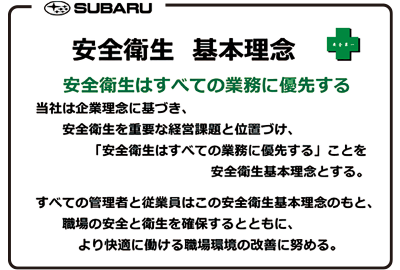
Basic Health and Safety Policy
With the aim of reducing industrial accidents, traffic accidents, illnesses, fires, and other incidents to zero, every individual will strive to create a safe, comfortable workplace through efforts to improve facilities, environments, and work methods, and to enhance management and awareness, based on a shared recognition of the importance of health and safety.
Established in April 2002
Management System
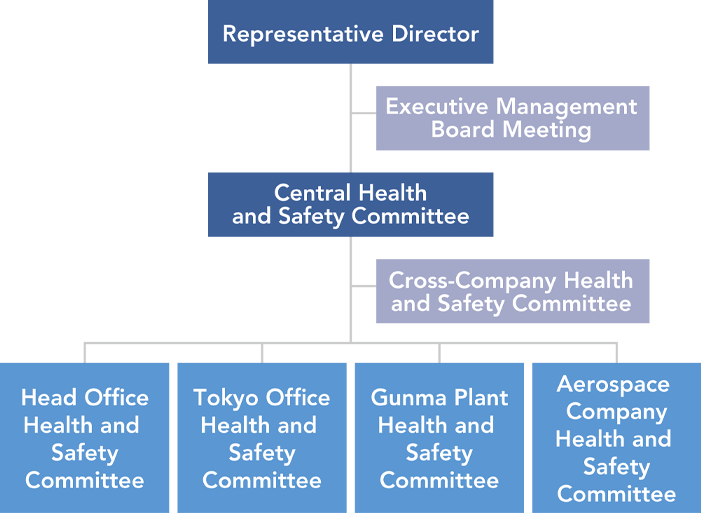
SUBARU has established a Central Health and Safety Committee to advance occupational safety and health initiatives for all employees (including temporary employees) at SUBARU and its affiliated companies.
As of July 2025, the Chief General Manager of the Monozukuri Division has chaired the Central Health and Safety Committee, formerly chaired by the General Manager of the Human Resources Department, to promote occupational safety and health activities from a position closer to production sites. The President of the Aerospace Company and Vice Executive Chair of the Subaru Labor Union serve as vice chairs of the committee. The Committee consists of Executive Officers and General Managers responsible for health and safety at each site.
In addition, each site has established its own Site Health and Safety Committee linked to the Central Health and Safety Committee. These committees carry out occupational health and safety activities while ensuring that necessary information is communicated not only to SUBARU employees at each site but also to workers from affiliated companies and resident contractors on our premises.
At the Gunma Plant, which serves as a hub for automotive development and manufacturing, we regularly share occupational health and safety information with overseas affiliates, including Subaru of Indiana Automotive, Inc., to support their occupational health and safety activities.
Occupational Health and Safety Promotion System
Targets and Results
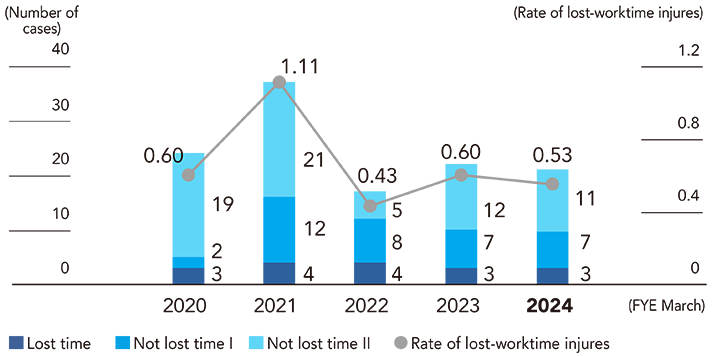
At SUBARU, we have identified two key indicators requiring particular focus: the frequency rate of industrial accidents with respect to the occupational safety area, and the rate of mental health-related leave days with respect to the health promotion area.
Targets (SUBARU)
(FYE March)
| Field | Indicator | Results | Targets | ||
|---|---|---|---|---|---|
| 2024 | 2025 | 2026 | 2029 | ||
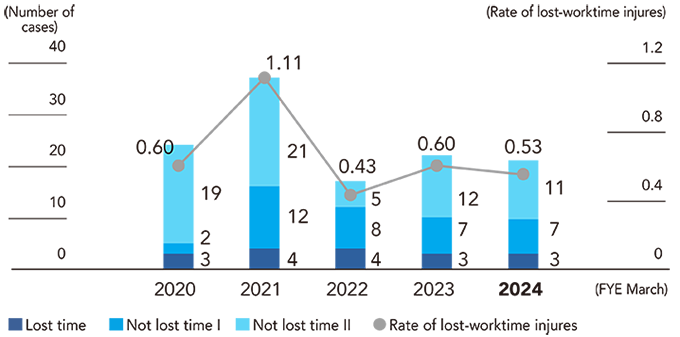
| Occupational Safety | Industrial accident frequency rate | 0.53 | 0.53 | 0.46 | No more than 0.33 |
| Health Promotion | Rate of mental health-related leave days | 0.93 | 0.92 | 1.09 | No more than 0.8 |
Industrial Accident Cases and Frequency Rate (SUBARU)
Initiatives
The Central Health and Safety Committee, through the health and safety committees at each site, disseminates targets and plans related to the focus areas of occupational safety, occupational health, health promotion, traffic safety, and fire prevention to employees and promotes related activities.
Occupational Safety
Identification of Industrial Accident Risks
[Critical Hazard Sources]
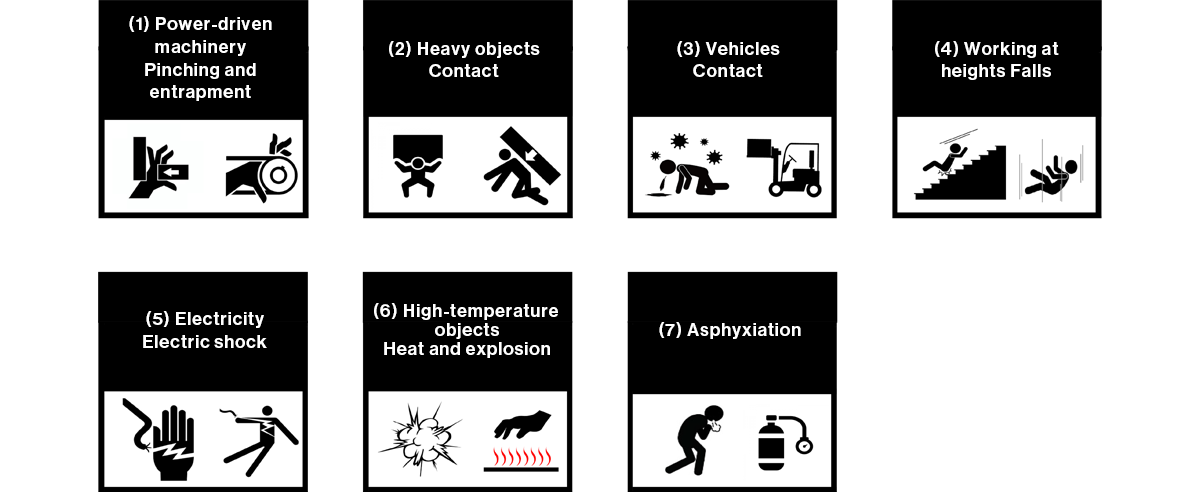
SUBARU has defined the Seven Critical Hazard Sources as situations prone to industrial accidents and has established a shared understanding of these across the entire SUBARU Group.
Seven Critical Hazard Sources
New Risks in Electrification Businesses
With a view to the full-scale launch of battery electric vehicle (BEV) production, a new business venture, SUBARU has begun conducting occupational safety risk assessments. We are identifying hazards specific to battery electric vehicles, such as high-voltage work and battery handling, and are proceeding with the development of SUBARU-wide safety rules. Going forward, we will develop concrete measures to prevent industrial accidents from the perspectives of safety assurance in management and operations, organizational structure and training, protective equipment and facilities, emergency response, and disposal and processing procedures.
Prevention of Industrial Accidents
To prevent industrial accidents caused by the identified hazard sources, SUBARU is implementing initiatives such as identifying near-misses*1 and reviewing work conditions and procedures. Furthermore, factors contributing to industrial accidents include not only unsafe behaviors—such as a lack of standard operating procedures or deviations from them—but also unforeseen abnormal states, such as unexpectedly applying too much force or a hand slipping. Such incidents can occur even during tasks that appear safe at first glance, and are characterized by the difficulty of anticipating them in advance. SUBARU shares examples of industrial accidents and near-misses that have occurred at each site and affiliated company, including these hard-to-anticipate incidents, along with the insights gained from them, across all sites and affiliated companies. This enables other locations to identify situations where industrial accidents could occur and take preventive measures.
The analysis of industrial accidents in FYE March 2025 confirmed that a decrease in awareness of danger due to factors such as familiarity with work was a major contributing factor. Based on this, in FYE March 2026, we placed a strong emphasis on raising safety awareness and promoted back-to-basic safety activities, such as pointing and calling, personal safety declarations, and sharing and utilizing near-miss information.
- *1
- An event that could have led to an incident, even if it did not result in one
Occupational Health
Work Environment Enhancements
[Measures against Heatstroke]
In FYE March 2026, SUBARU prioritized heatstroke prevention measures across all its sites. Main initiatives in this area were as follows:
- Facility measures: We upgraded air conditioning systems to improve work environments.
- Worker support: We provided air-conditioned workwear, drinking water, and salt candies.
- Education and awareness: We conducted training on heatstroke and used emails and on-site digital signage to raise awareness and disseminate relevant information.
Health Promotion
Mitigating Mental Illness
Appropriately addressing mental health issues is a critical initiative for maintaining the health of each employee while simultaneously achieving sustainable productivity improvements. At SUBARU, we promote one-on-one meetings between supervisors and subordinates based on the results of the INSIDES survey*1, which helps enable the early detection, prevention, and resolution of mental health issues.
For details on SUBARU’s mental health initiatives, please see the following link.
Human Resources: Health Management
- *1
- A tool that uses a questionnaire format to visualize employees’ psychological states and their attitudes and perceptions toward work
Traffic Safety
SUBARU implements measures to prevent employees from getting involved in any traffic accidents while working, commuting, or enjoying their private time. Main initiatives in this area were as follows:
- Conduct awareness-raising activities, including sharing the cases of past accidents and showing a video on traffic safety, before the start of a long vacation, targeting all plant and site employees, many of whom commute by car.
- Organize a lecture by the chief of the local police station to improve employees’ driving manners.
- Provide new employees with hands-on traffic safety training using actual vehicles in partnership with driving schools. Participants experience the risks of dangerous driving and traffic accidents firsthand to raise their awareness of accident prevention.
- Conduct psychological driving aptitude tests and use a driving recorder to help employees recognize their driving habits.
Fire Prevention
In addition to the risk to human life at the time of a fire, fires also carry the risk of long-term production and research shutdowns. SUBARU is advancing initiatives aimed at achieving zero fires, including even minor ones.
Furthermore, in the unlikely event of a fire, hazardous materials used within the facility can cause the fire to spread. SUBARU strives to reduce fire risks by thoroughly ensuring the proper management of these hazardous materials.
Training and Awareness
Initiatives at the Gunma Plant
[Safety Training for New Workers]
At the Gunma Plant, we provide occupational health and safety education at the plant’s Training Center for new workers.
The 10-day curriculum includes practical skills training using mock production lines tailored to the new workers’ assigned processes, as well as education designed to cultivate hazard sensitivity in an environment that allows trainees to visualize actual incidents.
In FYE March 2026, approximately 4,200 employees completed this training.
In addition, new workers undergo training on the protective equipment used on the job and the rules for wearing it; they are assigned to their respective workplaces only after completing this training.
[Safety Training for a Wide Range of Workers]
The Gunma Plant operates the Hands-on Safety Dojo as part of its occupational health and safety training. This initiative targets a wide range of workers, including SUBARU Group employees and temporary employees, as well as employees of contractors and subcontractors working on our premises, employees involved in construction work on our premises, and employees of suppliers. By utilizing hands-on training simulators reproducing situations involving industrial accidents—such as a fall, cut, pinch, or entrapment—we aim to enhance safety awareness.
In FYE March 2026, approximately 4,600 people participated in the program.
Promoting the Practice of Pointing and Calling
At each SUBARU site, to prevent human error, we urge employees to practice pointing and calling as the basis for occupational safety, not only at crosswalks on the premises but also during various work tasks and activities. Through this, we aim to raise awareness of safe behavior and improve the accuracy of safety checks.
Health and Safety Slogan Contest
SUBARU invites all employees to submit occupational safety slogans to be used in the following fiscal year with the aim of raising awareness of health and safety. Slogans are solicited under four themes: occupational safety, occupational health, traffic safety, and health management. In FYE March 2026, around 15,014 slogans were received. The slogan selected as the Grand Prize winner was “A Workplace Where We Can Speak Up for Safety.”
Initiatives in Collaboration with Suppliers
SUBARU and its four consolidated subsidiaries in Japan (Fuji Machinery Co., Ltd., Subaru Logistics Co., Ltd., Ichitan Co., Ltd., and Kiryu Kogyo Co., Ltd.) have established and operate the SUBARU Safety and Environment Council in collaboration with their supplier partners to raise occupational health and safety standards. This council, in which SUBARU and its suppliers participate, serves as a forum for promoting occupational health and safety activities while sharing challenges and best practices.
In particular, with a focus on occupational safety, occupational health, traffic safety, and fire prevention, the council holds an annual general meeting and, in collaboration with suppliers, shares information regarding industrial accidents involving lost time and traffic accidents, as well as conducts training programs for new employees, supervisors, and full-time managers.
Initiatives at Subaru of Indiana Automotive, Inc.
Since its inception, Subaru of Indiana Automotive, Inc. has been committed to occupational safety as a top priority alongside quality. As a result, the company maintains one of the lowest occupational illness rates in the U.S. automotive industry. The company obtained ISO 45001 (occupational health and safety management systems) certification in August 2024, and is working to provide employees with a safe and healthy working environment and prevent industrial accidents and occupational illnesses.
Decision to Implement an Occupational Health and Safety Management System (OHSMS)
In FYE March 2026, SUBARU decided to implement an OHSMS at all of its facilities to systematically advance the occupational health and safety activities it has been carrying out. Moving forward, led by the Central Health and Safety Committee, we will advance risk assessments, target management, and improvement activities to strengthen occupational health and safety initiatives across the entirety of SUBARU.