
Corporate Governance
- Basic Policy
- Management System
- Board of Directors
- Initiatives for improving effectiveness of the Board of Directors
- Governance and Executive Nomination Meeting
- Executive Compensation Meeting
- Evaluation Results of the Effectiveness of the Board of Directors
- Approach to the CEO Succession Plan
- Executive Training
- Outside Directors
- Compensation for Directors
- Preventing Conflicts of Interest
- Audit & Supervisory Board
- Internal Auditing
- Internal Control
- Internal Control System Related to Financial Reporting
- Cross-Shareholding
Basic Policy
The Company has articulated the vision “Delivering Happiness to All” and works on the enhancement of corporate governance as one of the top priorities of management, in order to gain the satisfaction and trust of all its stakeholders by achieving sustainable growth and improving its corporate value in the medium and long term.
- 〈Vision〉
- Delivering Happiness to All
- 〈Value statement〉
- “Enjoyment and Peace of Mind”
- 〈Corporate statement〉
- We aim to be a compelling company with a strong market presence built upon our customer-first principle.
The Company clearly separates the function of decision making and the oversight of corporate management from that of the execution of business operations, and aims to realize effective corporate management by expediting decision making.
In addition, the Company seeks to ensure proper decision making and the oversight of corporate management and the execution of business operations, as well as enhance its risk management system and compliance system through the monitoring of its management and operations and advice provided by outside officers.
We also implement proper and timely disclosure of information in order to improve the transparency of management.
The Company has created and disclosed the Corporate Governance Guidelines with the objective of clarifying the basic concept, framework, and operating policy of its corporate governance.
- Corporate Governance Guidelines (Prior to the Revision of June 24, 2026)PDF/690kB (September 5, 2025)
- Corporate Governance Guidelines (Revised on June 24, 2026)PDF/317kB (June 24, 2026)
- Corporate Governance ReportPDF/1.2MB (June 25, 2026)
- Action to Implement Management That Is Conscious of Cost of Capital and Stock PricePDF/392kB (June 25, 2026)
Management System
At the 95th Ordinary General Meeting of Shareholders held on June 24, 2026, it was resolved that the Company shift its corporate governance system from a company with an audit & supervisory board to a company with an audit and supervisory committee.
The Board of Directors makes core business decisions, such as those involving basic management policy, and oversees the execution of business, while the Audit and Supervisory Committee audits the performance of duties by Directors.
The delegation by the Board of Directors of decisions on the execution of important business to individual Directors is aimed at speeding up management decision-making, further enhancing deliberations by the Board of Directors, and strengthening oversight functions.
The Company established the Governance and Executive Nomination Committee and Executive Compensation Committee as voluntarily established committees, a majority of each of which are Independent Outside Directors, with the aim of strengthening the independence, objectivity, and accountability of Board of Directors functions pertaining to the nomination and compensation, etc. of Directors, the CEO, and other members of the management team, thus strengthening the effectiveness of the corporate governance system.

FY2026 Composition of the Board of Directors, Governance and Executive Nomination Committee, Executive Compensation Committee, and Audit and Supervisory Committee
| Position | Name | Board of Director | Governance and Executive Nomination Committee | Executive Compensation Committee | Audit and Supervisory Committee |
|---|---|---|---|---|---|
| Representative Director | Fumiaki Hayata | ◎ | ○ | ○ | |
| Representative Director | Atsushi Osaki | ○ | ○ | ○ | |
| Director | Tetsuo Fujinuki | ○ | |||
| Director | Shinsuke Toda | ○ | |||
| Outside Director | Fuminao Hachiuma | ○ | ○ | ○ | |
| Outside Director | Shigeru Yamashita | ○ | ◎ | ◎ | |
| Outside Director | Kayako Omura | ○ | ○ | ○ | |
| Director (Standing Audit and Supervisory Committee Member) |
Jinya Shoji | ○ | ◎ | ||
| Outside Director (Audit and Supervisory Committee Member) |
Yuri Furusawa | ○ | ○ | ○ | |
| Outside Director (Audit and Supervisory Committee Member) |
Yasumasa Masuda | ○ | ○ | ○ | |
| Outside Director (Audit and Supervisory Committee Member) |
Yukiko Mitsuhashi | ○ | ○ |
◎ indicates the Chairperson, and ○ indicates Members.
Major Items Deliberated in FYE March 2026
The principal activities of the Board of Directors, the Governance and Executive Nomination Meeting, and the Executive Compensation Meeting are as follows.
Board of Directors
The Board of Directors is comprised of eight members including three highly independent Outside Directors. Chaired by Director and Chairman Tomomi Nakamura, it met 13 times* during the fiscal year under review.
*In addition to these Board of Directors meetings, one resolution was adopted in writing that was deemed to be a resolution of the Board of Directors in accordance with Article 370 of the Companies Act and the Articles of Incorporation of the Company.
<Main themes of deliberations in FYE March 2026>
- Determination of candidates for Directors and Audit & Supervisory Board Members, as well as the CEO and other members of the management team
- Matters pertaining to repurchase and cancellation of own shares
- Revision of the executive compensation system and the policy for determining details of the compensation for individual Directors, and delegating matters regarding the determination of compensation, etc. for individual Directors and Executive Officers based on the executive compensation system to the Executive Compensation Meeting
- Discussions on reports related to medium- and long-term management issues, including the EV strategy, IR/SR activities, the Sustainability Committee, and the Risk Management and Compliance Committee
- Discussions on initiatives for realizing management conscious of cost of capital and stock price
- Discussions on ideal state of the Board of Directors in terms of speeding up management decision-making and strengthening oversight functions, as well as revisions to standards for deliberation to achieve the same
- Discussions concerning changes in organizational design that would lead to improvements of corporate value of the Company
- Formulation of the SUBARU Management Policy 2025
Initiatives for improving effectiveness of the Board of Directors
In order to improve the effectiveness of the management oversight functions of the Board of Directors, the Company provides information and knowledge regarding its business activities that is necessary to oversee corporate management on an ongoing basis to Directors and Audit & Supervisory Board Members.
In order to deepen understanding of the Company’s management statement, corporate culture, and business environment, business divisions submit reports to outside officers, and opportunities are created for outside officers to tour key business sites in Japan and overseas.
Furthermore, the Company works to establish an environment that facilitates free and open discussion by explaining the content of the agenda for meetings of the Board of Directors in advance to Outside Directors and Outside Audit & Supervisory Board Members, and by encouraging the mutual sharing information and the exchange of opinions among officers.
Management Roundtable Discussions
Management roundtable discussions are held with the objective of enhancing deliberations by the Board of Directors, and are attended by Directors and Audit & Supervisory Board Members (12 persons).
This is a non-statutory meeting for officers to mutually share information and exchange opinions on important business themes.
Four such meetings were held during the fiscal year under review.
<Main themes of discussions in FYE March 2026>
- Our future vision
- The concept of the Company’s Board of Directors and governance
- SUBARU’s aerospace business
- Investment plans for the new Oizumi Plant project, and progress made
- Result of the evaluation of effectiveness of the Board of Directors
Governance and Executive Nomination Meeting
The Governance and Executive Nomination Meeting is comprised of three highly independent Outside Directors (Miwako Doi, Fuminao Hachiuma, and Shigeru Yamashita) and two internal Directors (Tomomi Nakamura and Atsushi Osaki). As an advisory body to the Board of Directors, it deliberates and submits reports on important matters concerning officer appointments and governance.
Chaired by Director and Chairman Tomomi Nakamura, it met nine times during the fiscal year under review. In addition, one Audit & Supervisory Board Member (Yuri Furusawa) attended as an observer.
*Effective June 24, 2026, the “Governance and Executive Nomination Meeting” was renamed the “Governance and Executive Nomination Committee.”
<Main themes of deliberations in FYE March 2026>
- Consideration of successor planning for the management team, including the CEO
- Human resource development through the implementation of 360-degree evaluation of officers using the skills matrix for executives including non-Director Executive Officers
- Improving the transparency of the officer evaluation process by sharing performance results of Executive Officers
- Reports on the Company’s officer structure, personnel matters and the division of duties, as well as on executive appointment proposals for major subsidiaries, and other matters
- Discussions on which organizational design should be selected to contribute to improvements in corporate value over the medium to long term, achieved through deliberations on the concept of a distinctively Subaru corporate governance, and discussion of the Board of Directors concept after changes in organizational design, including delegation of decisions on execution of important business
Executive Compensation Meeting
The Executive Compensation Meeting is comprised of three highly independent Outside Directors (Miwako Doi, Fuminao Hachiuma, and Shigeru Yamashita) and two internal Directors (Tomomi Nakamura and Atsushi Osaki), and deliberates and submits reports on matters concerning Director and Executive Officer compensation.
Chaired by Director and Chairman Tomomi Nakamura, it met eight times during the fiscal year under review. In addition, one Audit & Supervisory Board Member (Yasumasa Masuda) attended as an observer.
*Effective June 24, 2026, the “Executive Compensation Meeting” was renamed the “Executive Compensation Committee.”
<Main themes of deliberations in FYE March 2026>
- Consideration of executive compensation levels and reasonableness of performance-linked compensation using external survey data
- Determination of individual performance-linked compensation amounts for Directors (excluding Outside Directors) and Executive Officers based on their evaluation results
- Considered compensation for Outside Directors after taking into account changes in organizational design
- Determination of individual base amounts, etc., for restricted stock compensation
Composition of the Board of Directors, Governance and Executive Nomination Meeting, and Executive Compensation Meeting, Number of Meetings Held and Attendance in FYE March 2026
| Position | Name | Board of Directors | Governance and Executive Nomination Meeting |
Executive Compensation Meeting |
|---|---|---|---|---|
| Representative Director | Atsushi Osaki | 〇 100% (13/13) |
〇 100% (9/9) |
〇 100% (8/8) |
| Representative Director | Fumiaki Hayata | 〇 100% (13/13) |
||
| Director | Tomomi Nakamura | ◎ 100% (13/13) |
◎ 100% (9/9) |
◎ 100% (8/8) |
| Director | Katsuyuki Mizuma | 〇 100% (3/3)*1 |
||
| Director | Tetsuo Fujinuki | 〇 100% (13/13) |
||
| Director | Shinsuke Toda | 〇 100% (10/10)*2 |
||
| Outside Director | Miwako Doi | 〇 100% (13/13) |
〇 100% (9/9) |
〇 100% (8/8) |
| Outside Director | Fuminao Hachiuma | 〇 100% (13/13) |
〇 100% (9/9) |
〇 100% (8/8) |
| Outside Director | Shigeru Yamashita | 〇 100% (13/13) |
〇 100% (9/9) |
〇 100% (8/8) |
| Standing Audit & Supervisory Board Member | Yoichi Kato | 〇 100% (3/3)*1 |
||
| Standing Audit & Supervisory Board Member | Hiromi Tsutsumi | 〇 100% (13/13) |
||
| Standing Audit & Supervisory Board Member | Jinya Shoji | 〇 100% (10/10)*2 |
||
| Outside Audit & Supervisory Board Member | Yuri Furusawa | 〇 100% (13/13) |
||
| Outside Audit & Supervisory Board Member | Yasumasa Masuda | 〇 100% (13/13) |
◎ indicates the Chairperson, and 〇 indicates Members.
- *1
- Director Katsuyuki Mizuma and Standing Audit & Supervisory Board Member Yoichi Kato (who retired in June 2025) attended all three meetings of the Board of Directors held prior to their retirement.
- *2
- Director Shinsuke Toda and Standing Audit & Supervisory Board Member Jinya Shoji attended meetings of the Board of Directors held after their appointment as Director and Audit & Supervisory Board Member, respectively, at the 94th Ordinary General Meeting of Shareholders held on June 25, 2025.
Evaluation Results of the Effectiveness of the Board of Directors
The Board of Directors every year conducts analysis and evaluation on the effectiveness of the Board of Directors (“BoD”) in accordance with Article 23 of the Corporate Governance Guideline, and reviews and implements improvement measures for the issues identified.
In the fiscal year ended March 31, 2026, aiming to apply the results of the evaluations toward enhancing the BoD’s functions, the BoD confirmed efforts to address issues recognized by the previous fiscal year, reorganized the evaluation items on the survey and implemented interviews with certain Directors and Audit & Supervisory Board Members, and assessed and analyzed the reasons and underlying factors behind differences in the recognition of issues.
<Methods of evaluation and analysis>
- (1)
- Timing: December 2025 – January 2026
- (2)
- Methods: Self-evaluation questionnaire survey and interviews conducted by a third-party body
- Survey respondents: Eight Directors and four Audit & Supervisory Board Members for a total of 12 respondents
- Interviewees: Chairman of the BoD; Representative Director, President; Outside Directors (3 persons); Outside Audit & Supervisory Board Members (2 persons): Total of seven persons
- (3)
- Process
- BoD secretariat conducts and analyzes anonymous self-evaluation questionnaire survey of Directors and Audit & Supervisory Board Members
- Based on the results of the questionnaire, a third-party body conducts and evaluates interviews with the Chairman of the BoD, the Representative Director, President, Outside Directors, and Outside Audit & Supervisory Board Members
- Reports prepared by the third-party body and the secretariat to the BoD are validated and discussed at Management Roundtable Discussions and meetings of the BoD
- (4)
- Evaluation items on the survey
| (i) BoD roles and functions | (vi) BoD risk management and internal control |
| (ii) BoD composition | (vii) Governance and Executive Nomination Meeting and Executive Compensation Meeting operation |
| (iii) BoD operation | (viii) Shareholder dialogue |
| (iv) BoD support system | (ix) Continued BoD improvements |
| (v) BoD culture and communication |
Evaluation results
Based on the third-party body’s report detailing its aggregation and analysis, the BoD discussed and confirmed the following points.
- (1)
- General evaluation
The evaluation confirmed that the Company’s BoD is effective.
- (2)
- Characteristics of the Company’s BoD
| Item | Summary |
|---|---|
| Support by the BoD for execution based on strong relationships of trust between supervision and execution | During a time in which the business environment was changing rapidly due to such factors as tariff policies in the key market of the U.S. and the sudden slowdown of the EV market, the strong relationships of trust between supervision and execution demonstrated the former acting as a support function for the decision-making of the latter. |
| BoD conducive to free and open discussion | Based on mutual understanding and relationships of trust between outside and internal officers, a culture of free, open, constructive, and transparent discussion has been fostered. |
| BoD with high awareness of shareholder dialogue | Information obtained through dialogue with shareholders and investors is reported periodically and consistently to the BoD, and is an important element of its supervision and decision-making. |
- (3)
- Status of responses to the issues pointed out in the previous fiscal year
| Item | Summary |
|---|---|
| Roles required of the BoD in an uncertain business environment (improvements still in progress) | The BoD made progress in improving management of meetings by seeking to deeper discussions of major risks and important management issues to be monitored intensively. In addition, the transition to a company with an audit and supervisory committee is expected to lead to further enhancements to the setting of agenda items. |
| Further strengthening of monitoring structure throughout the Group (improvements still in progress) | Looking ahead to the transition to organizational audits, it is expected that there will be a further deepening of discussions between Directors and Audit & Supervisory Board Members, such as the aligning of perceptions with regard to the ideal state of Group governance structure and the timeline for its realization. Going forward, on the assumption that the transition to a company with an audit and supervisory committee will take place, we expect a further deepening of discussions on the best approach to monitoring the big picture for the Group as a whole. |
| Clarification of roles of various meeting bodies (improved) | The Company has taken the issues raised in the effectiveness evaluation of the previous fiscal year seriously, and measures for improvement have been steadily executed. Specifically, the BoD moved forward in such areas as participation of Audit & Supervisory Board Members as observers in the Governance and Executive Nomination Meeting and the Executive Compensation Meeting, enhanced consideration of governance-related agenda items in advance, provision of important meeting information to outside officers, and greater opportunities for dialogue with Executive Officers. |
- (4)
- Overview of the Management Roundtable Discussions for further enhancement of the effectiveness of the BoD
The Management Roundtable Discussions were centered on the following points based on the results of the third-party evaluation and the issues pointed out in the evaluation.
| Item | Summary |
|---|---|
| Forming of consensus with regard to role of the BoD | With regard to items that should be monitored by the BoD, and their scope, the importance of committing to more in-depth considerations was confirmed. In addition, the decision has been made to clarify the role of the BoD, as it seeks to become a monitoring board, in a company with an audit and supervisory committee, and also to enhance discussions in the BoD and Management Roundtable Discussions on important medium- to long-term themes, including the ideal form of involvement by Outside Directors. |
| Further enhancements to the setting of agenda items | From the perspective of making effective use of the limited time of the BoD, we reconfirmed the importance of setting agenda items to establish what the BoD should actually be discussing, including the management of standards for deliberation, the use of written resolutions, and the expansion of free and open discussion. Another point that was shared was the necessity of seeking to install mechanisms for leveraging to a greater extent the knowledge and experience of outside officers when considering and setting agenda items for the year, and establishing related processes. |
| Considering the ideal composition of the BoD | From the perspective of increasing our ability to respond to risks in the external environment, we confirmed that there is potential for the BoD as a whole to engage in strategic consideration of the question of “What sort of knowledge do we want to supplement, and how do we want to supplement it?” There was shared recognition that, rather than assigning human resources in all directions, there should be focused supplementation of knowledge that is aligned with the characteristics of the Company’s business and management priorities. The necessity of continuously enhancing discussions of board succession by the BoD and the Governance and Executive Nomination Meeting was also demonstrated. |
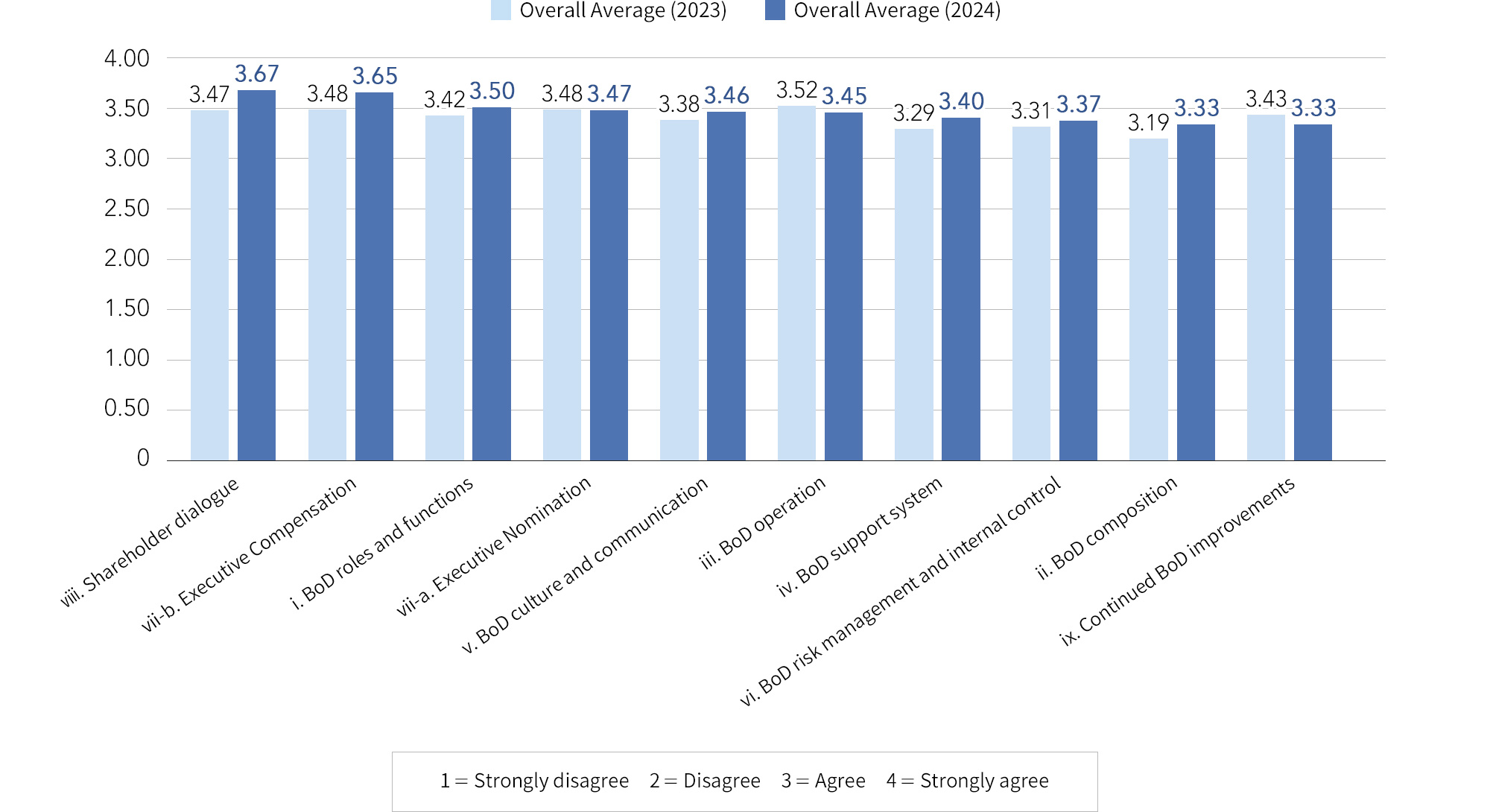
Survey results
<Survey question items>
| Evaluation Item | |
|---|---|
| i. BoD roles and functions | Recognition of the roles and functions of the BoD |
| Delegation of authority to execution | |
| Reporting system | |
| Supervision of corporate management | |
| ii. BoD composition | Size of the BoD |
| BoD composition (proportion of inside and Outside Directors) | |
| Composition of the BoD (diversity and expertise) | |
| iii. BoD operation | Frequency, length, and time allocation of meetings |
| Relevance of agenda items | |
| Timing of proposals and discussions | |
| Quality and quantity of documents | |
| Timing of document distribution | |
| Prior explanation | |
| Content of explanations and reports | |
| Discussions by the BoD | |
| Leadership by the Chair | |
| iv. BoD support system | Environment and systems for the provision of information |
| Provision of information to outside officers | |
| Training of outside officers | |
| Training of inside officers | |
| v. BoD culture and communication | Diverse values |
| Stakeholder perspectives | |
| Directors and business divisions | |
| Inside and Outside Directors | |
| Directors and Audit & Supervisory Board Members | |
| vi. BoD risk management and internal control | Risk management |
| Group governance | |
| Internal control and compliance | |
| vii. Governance and Executive Nomination Meeting and Executive Compensation Meeting operation | |
| viii. Shareholder dialogue | Supervision of proper disclosure of information to shareholders and investors |
| Sharing the views of shareholders and investors | |
| Enhancing dialogue with shareholders and investors | |
| ix. Continued BoD improvements | Status of improvements based on the previous fiscal year's effectiveness evaluation |
<Survey results>
Approach to the CEO Succession Plan
The Company’s Board of Directors believes that specific initiatives for formulation and implementation of CEO succession plan may differ depending on the situation of each company, corporate culture, and status of candidate human resources and that it is important to continuously discuss necessary initiatives and repeatedly devise initiatives through trial and error to ensure a successful succession at the right timing. For that reason, the Company has formulated the CEO Succession Plan, which forms the base of discussion, as well as Abilities Required of the SUBARU Group’s CEO and the five key qualities required of the Group’s CEO, taking into consideration the objective of ensuring objectivity and transparency of the process for nominating successors.
CEO Succession Plan
The Company recognizes that decision making regarding top management changes (e.g., the CEO) and successor selection may have a critical influence on corporate value. Therefore, in order to ensure a successful succession at the right timing, we invest substantial time and resources to carefully develop and implement succession plans.
In order to hand over the business to the right person, the Board of Directors, as part of its essential duties, develops succession plans that can convince all stakeholder groups. To ensure objectivity and transparency in the process for deciding on the replacement and selection of the CEO, the Board of Directors appropriately supervises the preparation of proposals by the current CEO through discussions at the Governance and Executive Nomination Committee.
To be able to implement succession plans appropriately, the CEO begins to prepare for selection and development of their successor candidates independently upon assuming office. Key processes for this purpose include providing information on candidates to Independent Outside Directors on an ongoing basis, particularly by enabling the directors to monitor the candidates in person continuously in day-to-day business settings, as a measure to ensure appropriate and timely evaluation and selection down the road.
The Board of Directors and Governance and Executive Nomination Committee meet on a regular basis to review the list of essential qualities and skills required of the CEO, which may include removing and adding items, in consideration of perception of current trends, changes in the business environment surrounding the Company, and the future direction of the Group’s business strategies.
To ensure the objectivity of the successor selection process and increase the effectiveness of its supervision by the Board of Directors and Governance and Executive Nomination Committee, it is important to have effective selection criteria in place, particularly for use by Independent Outside Directors. To this end, the Company discloses two sets of criteria: “Abilities required of the SUBARU Group’s CEO” and “Five key qualities required of the SUBARU Group’s CEO.” These criteria serve as a guide for evaluating candidates in light of quality, competency, experience, track record, specialized expertise, personality, and other factors, which have been discussed and decided on by the Board of Directors and Governance and Executive Nomination Committee.
Abilities Required of the SUBARU Group’s CEO
The SUBARU Group’s CEO must be able to: properly understand the business environment surrounding SUBARU, its corporate culture and philosophy, business growth stages, and medium- to long-term management strategies and challenges; facilitate collaboration appropriately with various stakeholders; and lead all executives and employees to work together to maximize corporate value.
Five key qualities required of the SUBARU Group's CEO
1. Integrity
2. Broad perspective
3. Character
4. Tireless spirit or revolutionary leadership skills
5. Person of action
Executive Training
| Category | Training policy / Major training programs |
|---|---|
| Directors | PolicyThe Company provides its Directors with information and knowledge regarding its business activities that is necessary for them to fulfill their responsibilities to oversee and audit management on an ongoing basis. |
Training
|
|
| Outside Directors | PolicyThe Company provides its Outside Directors with information relating to the Company’s corporate statement, corporate culture, business environment, and other matters on an ongoing basis, mainly by arranging appropriate opportunities, such as operations briefings from business divisions and factory tours, as well as by creating an environment for officers to share information and exchange opinions more easily. |
Training
|
|
| Executive Officers | PolicyThe Company gives Executive Officers similar opportunities as those given to Directors, for the purpose of developing human resources to lead its management in the future. |
Training
|
*Expenses incurred for the above training are borne by the Company.
| Category | Major results in FYE March 2026 |
|---|---|
| All executives (including outside officers) | Externally hosted seminars: newly appointed Directors and Executive Officers |
| Lectures by invited experts: Lectures on such management themes as responding to electrification and sustainability: 2 held in total |
|
| Outside Directors / Outside Audit & Supervisory Board Members | Explanations of the business from and discussions with Executive Officers |
| Discussions with Directors, including internal Directors, and Audit & Supervisory Board Members on management issues: 4 held in total | |
| Provision of important meeting materials from the executive side, e.g. from Management Meetings, and sharing an explanation of important information | |
| Participation in internal presentations on future technology, quality, and other matters, as well as attendance at exhibitions, etc. |
Outside Directors
- Outside Directors are expected to fulfill the two roles of overseeing management from a standpoint that is independent of the management team, and providing appropriate advice to management that is based on a wide range of sophisticated knowledge.
- In addition to the above two functions of oversight and advice, Outside Directors who are Audit and Supervisory Committee Members are expected to conduct audits from the viewpoint of legality and appropriateness on the basis of a wide range of advanced knowledge.
- The Company has established criteria for the independence of outside officers in addition to the criteria for independence established by the Tokyo Stock Exchange, and appoints independent outside directors who meet those criteria.
Please refer to the Corporate Governance Report for details regarding the reasons for the appointment of each Outside Officer.
Compensation for Directors
Matters concerning the policy for determining details of compensation for Individual Directors
The Company deliberated and decided on the proposal of the policy for determining details of compensation for individual Directors approved by the Executive Compensation Meeting at the Board of Directors meeting held on March 6, 2026. The Board of Directors has judged that the content of the compensation for individual Directors for the fiscal year under review adheres to the determination policy (including the determination policy that was revised by a decision of the Board of Directors on March 3, 2026, to the extent applicable to the fiscal year under review), as the Executive Compensation Meeting has been delegated by the Board of Directors to decide the details of the compensation, and has been decided after sufficient deliberations by the meeting members including Outside Directors.
Please refer to the Corporate Governance Report for details of the Policy for Determining Compensation for Individual Directors.
Overview of executive compensation system for Directors
Basic Compensation
Fixed monthly compensation is paid as basic compensation. The amount of compensation for each individual is determined based on position, taking into consideration factors such as the business environment.
Annual performance-linked bonuses (Short-term incentive)
Directors, excluding Outside Directors and Directors who are Audit and Supervisory Committee Members, shall receive annual performance-linked bonus by cash at a certain time of the year. The specific amount is determined according to a compensation table by position prepared using the consolidated profit before tax for the current fiscal year as a KPI.
Restricted Stock Compensation (Medium- to Long-term Incentive)
Fixed Compensation Type (RS)
Directors, excluding Outside Directors and Directors who are Audit and Supervisory Committee Members, are granted shares of the Company’s common stock at a certain time each year in an amount corresponding to a base amount determined in consideration of the Company’s business performance, the scope of each Director’s responsibilities, and other relevant factors.
Performance Share Unit Plan (PSU)
Directors, excluding Outside Directors and Directors who are Audit and Supervisory Committee Members, are granted units (one unit = one share) at a certain time each year in an amount corresponding to a base amount determined in consideration of the Company’s business performance, the scope of each Director’s responsibilities, and other relevant factors. After the evaluation period, shares of the Company’s common stock are delivered in a number calculated by multiplying the number of units by a payout ratio determined according to the level of achievement of performance targets.
<KPI for PSU in FYE March 2026>
For PSU performance evaluation, the Company uses consolidated ROE and relative TSR (compared to the TOPIX growth rate including dividends) as quantitative (financial) performance indicators, and improvement in the employee engagement score as a qualitative (non-financial) performance indicator.
Compensation System for Directors (Representative Director, President and CEO)

*The ratio of annual performance-linked bonuses and restricted stock compensation (variable/fixed compensation types) are indexed to a basic compensation of 1.
<Matters concerning resolutions of the General Meeting of Shareholders regarding Directors’ compensation, etc.>
At the 95th Annual General Meeting of Shareholders held on June 24, 2026, it was resolved that the total amount of compensation, etc. payable to Directors (excluding Directors serving as Audit and Supervisory Committee Members) shall not exceed ¥1.2 billion per year, of which no more than ¥200 million shall be payable to Outside Directors. The number of Directors (excluding Directors serving as Audit and Supervisory Committee Members) as of the conclusion of the said Annual General Meeting of Shareholders was seven, including three Outside Directors.
In addition, at the 95th Annual General Meeting of Shareholders held on June 24, 2026, it was resolved that the total amount of monetary compensation relating to restricted stock compensation shall not exceed ¥200 million per year within the above limit. The number of Directors eligible for such compensation as of the conclusion of the said Annual General Meeting of Shareholders was four, excluding Outside Directors, internal Directors serving as Audit and Supervisory Committee Members, and Directors residing outside Japan.
Total Compensation for Directors and Audit & Supervisory Board Members for FYE March 2026
| Category | Total compensation (millions of yen) | |||||
|---|---|---|---|---|---|---|
| Basic compensation (Paid in fixed monthly installments) |
Annual performancelinked bonuses | Restricted stock compensation |
||||
| PSU | RS | |||||
| Directors (9) | Inside Directors (6) |
233 | 67 | 60 | 63 | 423 |
| Outside Directors (3) |
40 | – | – | – | 40 | |
| Audit & Supervisory Board Members (5) |
Inside Audit & Supervisory Board Members (3) |
73 | – | – | – | 73 |
| Outside Audit & Supervisory Board Members (2) |
26 | – | – | – | 26 | |
| Total (14) | 372 | 67 | 60 | 63 | 562 | |
Notes:
- 1.
- Figures in the above table include one Director and one Audit & Supervisory Board Member who resigned before the last day of the fiscal period under review. At the end of the period, there were eight Directors, including three Outside Directors, and four Audit & Supervisory Board Members, including two outside Audit & Supervisory Board Members.
- 2.
- The total amount of the above indicates the amount recorded as an expense at the end of the period and includes undetermined compensation (phantom stock granted to non-residents, PSU, etc.).
- 3.
- The amounts of phantom stock and PSU were calculated using the closing price of the shares in the Company’s common stock on Prime Market of the Tokyo Stock Exchange on March 31, 2026. When they are granted in reality, the Company will apply the share price as of the issuance.
<Performance-linked compensation>
The table below shows the results of key performance indicators (KPIs) used to calculate the annual performance-linked bonus amounts and the number of PSUs granted corresponding to the financial results for the fiscal year under review.
The Company decides the annual performance-linked bonuses for individual Directors based on the consolidated profit before tax by setting a compensation table in which the higher his/her position is, the more closely his/her compensation is linked to annual performance.
In addition, in order to facilitate the achievement of the Group’s medium- and long-term strategy targets, the Company has adopted the Performance Share Units (PSU), in which the number of shares granted is linked to the degree of achievement of the targets for key financial indicator (ROE and relative TSR [compared to the TOPIX growth rate including dividends]) and non-financial indicator (employee engagement), for a portion of the restricted stock compensation to be granted as non-monetary compensation. Annual performance-linked bonuses and restricted stock compensation are not granted to Outside Directors in view of their roles of fulfilling monitoring and oversight functions of corporate management from an independent position.
| Performance indicators (KPI) | Results |
|---|---|
| Consolidated profit before tax | 107.5 billion yen |
| ROE | 3.3% |
| Relative TSR (compared to the TOPIX growth rate including dividends) |
61.7% |
| Employee engagement score improvement points |
Up 3 points |
<Non-monetary compensation>
The Company grants restricted stock units to Directors (excluding Outside Directors; hereinafter the same shall apply) for the purpose of providing them an incentive for sustained improvement of the Company’s corporate value and further value sharing with the shareholders, and provides monetary compensation for that (hereinafter, “Restricted Stock Compensation Plan”). Based on the resolution of the Board of Directors, Directors shall wholly contribute the monetary compensation claim paid as above in the form of properties contributed in kind, and shall, in return, receive shares of the Company’s common stock through issuance or disposal. In addition, for the issuance or disposal of shares of the Company’s common stock, the Company and eligible Directors shall enter into a restricted stock allotment agreement that includes provisions such as the one to restrict the transfer of the shares for the period starting from the date of allotment through the date the Director retires from the position (however, if the Director is consecutively appointed the Company’s Executive Officer after retiring from the Director’s position, the period through the date of retirement as Executive Officer).
Preventing Conflicts of Interest
The approval of the Board of Directors is obtained in advance where a transaction poses the risk of a conflict of interest. A report on the positions that each director has held concurrently over the past financial year is provided once a year at the April meeting of the Board of Directors (a report to confirm that there have been no improper transactions or positions held).
Audit & Supervisory Board
With the approval of shareholders at the 95th Ordinary General Meeting of Shareholders held on June 24, 2026, the Company transitioned from a company with an Audit & Supervisory Board to a company with an Audit and Supervisory Committee. Accordingly, the following description relates to the structure and activities of the Company prior to this transition.
The Audit & Supervisory Board is comprised of four Audit & Supervisory Board Members, including two highly independent Outside Audit & Supervisory Board Members. It deliberates and checks audit policy and implementation status.
Chaired by Standing Audit & Supervisory Board Member Hiromi Tsutsumi, the board met 12 times in FYE March 2026.
<Main resolutions and discussions in FYE March 2026>
- (1)
- Main matters for resolution
- Audit policy, audit plan, and division of audit duties for the fiscal year under review
- Consent to agenda items for the General Meeting of Shareholders (appointment of Audit & Supervisory Board Members)
- Preparation of the audit report
- Evaluation and selection / dismissal of the Accounting Auditor
- Consent to the audit fee for the Accounting Auditor
- (2)
- Main matters for reporting and sharing
- Sharing of the results of visiting audit of the Company’s business establishments and affiliated companies as well as observations
- Sharing of information regarding important matters of the Company’s Executive Management Board Meeting, Executive Meeting, etc. by Standing Audit & Supervisory Board Member with outside Audit & Supervisory Board Members
- Reports on risk management issues internally and in the industry that require special care from a preventive audit perspective
Opinions of individual Audit & Supervisory Board Members expressed at the meeting of Audit & Supervisory Board are presented to involved officers, etc. as needed to contribute to their forming appropriate executive decisions.
Internal Auditing
Internal audits at the Company are conducted by the Audit Department (16 members), which reports directly to the President. The Audit Department evaluates the status of the development and operation of internal controls and the effectiveness of risk management from an independent and objective standpoint with respect to the business activities of the Company and its domestic and overseas group companies, and provides recommendations and proposals for improvement.
As part of its efforts to ensure the effectiveness of internal audits, the Audit Department formulates an annual internal audit plan at the beginning of each fiscal year, taking into account the status of risks and internal controls across the Group, and conducts audits in a systematic manner. Internal audit reports are submitted directly to the President at monthly reporting meetings and are also distributed to all Directors, Corporate Auditors, and relevant departments. In addition, the Audit Department reports semi-annually to the Board of Directors and quarterly to a joint meeting consisting of all Executive Officers.
The Audit Department and the Corporate Auditors work closely together to strengthen the audit function. In addition, the Company seeks to enhance audit effectiveness through quarterly information sharing with the Accounting Auditor regarding audit plans, audit results, and other matters. Furthermore, the Audit Department regularly exchanges information with Group companies that have internal audit functions in order to promote coordination and cooperation.
The Audit Department also conducts annual self-assessments of its activities and periodically undergoes evaluations by external specialists to confirm that audit activities are being conducted appropriately.
Internal Control
Management System
With the aim of increasing the effectiveness of internal controls and risk management, the Internal Audit Department was made independent of the Risk Management Group (overseen by the Chief Risk Management Officer (CRMO)) to ensure a higher level of independence of internal audit units in the organization and to enhance the effectiveness of internal controls.
Internal Control System
As one of the key foundations for realizing the SUBARU Group’s vision of becoming a company “Delivering Happiness to All,” we position our internal control system accordingly. To ensure the appropriate operations of the SUBARU Group, we have, in accordance with the Companies Act and the Ordinance for Enforcement of the Companies Act, adopted a policy on the development of the internal control system by resolution of the Board of Directors.
Based on this policy, we maintain and operate our internal control system as a foundation that supports efficient and effective business management through compliance with laws and regulations, the acceleration of decision-making through delegation of authority from directors and the Board of Directors, and appropriate risk responses. At the same time, we continuously evaluate the effectiveness of the system and make timely and appropriate improvements as needed.
Internal Control System Related to Financial Reporting
Regarding internal control reporting systems pursuant to the Financial Instruments and Exchange Act, the evaluation of the internal control system related to financial reporting is dated the final day of the consolidated accounting period and is conducted in accordance with generally accepted assessment standards for internal control over financial reporting.
The President and Chief Executive Officer (CEO) and the Chief Financial Officer (CFO) evaluated the status of the development of the internal control system related to financial reporting as of March 31, 2026 and affirmed that it has been established properly and functions effectively, and issued an internal control report audited by the accounting auditors to that effect.
Cross-Shareholding
(1) Policy for cross-shareholding
The Company holds discussions with the companies whose shares it holds as cross-shareholdings and the Board of Directors every year measures the benefits of holding them quantitatively using dividend yield and capital cost using WACC and compares and verifies them. Based on the result, it continues with the cross-shareholdings only when it judges that they would qualitatively contribute to the medium- to long-term management and business strategies.
(2) Verification details for cross-shareholding
Based on the above policy, the Company has steadily reduced the number of listed stocks held as cross-shareholding. As a result, 60 issues held at the end of March 2015 decreased to 3 issues at the end of March 2026. At this point, the Company judges that retaining cross-shareholdings in the three issues is indispensable at this time for the reasons described below, and it will continue to hold discussions with these companies at least once a year and the Board of Directors will evaluate and examine the cross-shareholdings every year and judge whether or not to retain them.
| Issues | Number of shares | Amount reported on the balance sheet (millions of yen) |
Purpose of holding the shares |
|---|---|---|---|
| The Gunma Bank, Ltd. | 2,850,468 | 5,879 | The Gunma Bank, a local bank of the area where the Company’s main factory resides, is supporting not only the Company but also local supplier sites in Japan and abroad through its financial services. As the bank has been the Company’s important partner, the Company will continue to hold the bank’s shares to promote fair and smooth financial transactions. |
| Mizuho Financial Group, Inc. | 372,097 | 2,265 | The Mizuho Financial Group firms have been supporting the Company with financial transactions and other services. In particular, the Mizuho Bank has long been the Company’s most important financial partner, providing support in a broad area of management. The Company will continue to hold the group’s shares to promote fair and smooth transactions. |
| Dynamic Map Platform Co., Ltd. | 10,000 | 6 | The Company carries out research and pioneering development of autonomous driving and advanced driver assistance using high-precision 3D maps for automated driving offered by Dynamic Map Platform Co., Ltd. The Company will continue to hold the company’s shares to promote smooth transactions. |