
Compliance
Our Approach
SUBARU is working to instill and embed in all officers and employees of the SUBARU Group the practice of acting in accordance with social ethics and norms, in addition to complying with laws, regulations, and internal rules.
Through the establishment and operation of a compliance system and organization, as well as various training activities, we are working to ensure that all employees have a strong awareness that thorough compliance throughout SUBARU forms the foundation of our management, and that each and every employee thinks about compliance, engages in dialogue, and takes action to permeate “Insightful Compliance.”
Rules for Compliance
In striving to enhance its compliance-related initiatives, SUBARU has established various rules related to compliance, including the Group-wide Risk Management and Compliance Rules, which stipulate its compliance-related structures, organizations, and operational methods.
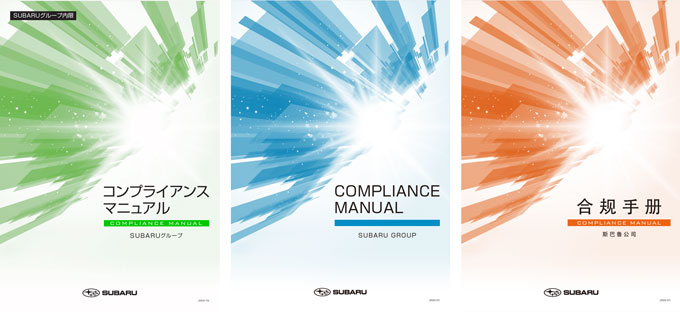
We have also established the Compliance Guidelines as a code of conduct for officers and employees to practice compliance in their daily business activities. Furthermore, the Compliance Manual (available in Japanese, English, and Chinese) has been prepared as a systematic guide to help them act in accordance with laws, regulations, compliance rules, and other internal rules, as well as social ethics and norms, and is disseminated to relevant parties. In addition, we have drafted the Compliance Manual: Essential Version to provide a clearer explanation of compliance.
SUBARU also distributes explanatory videos for the Compliance Manual via its intranet, which are utilized by each department for compliance training and awareness activities.
Management System
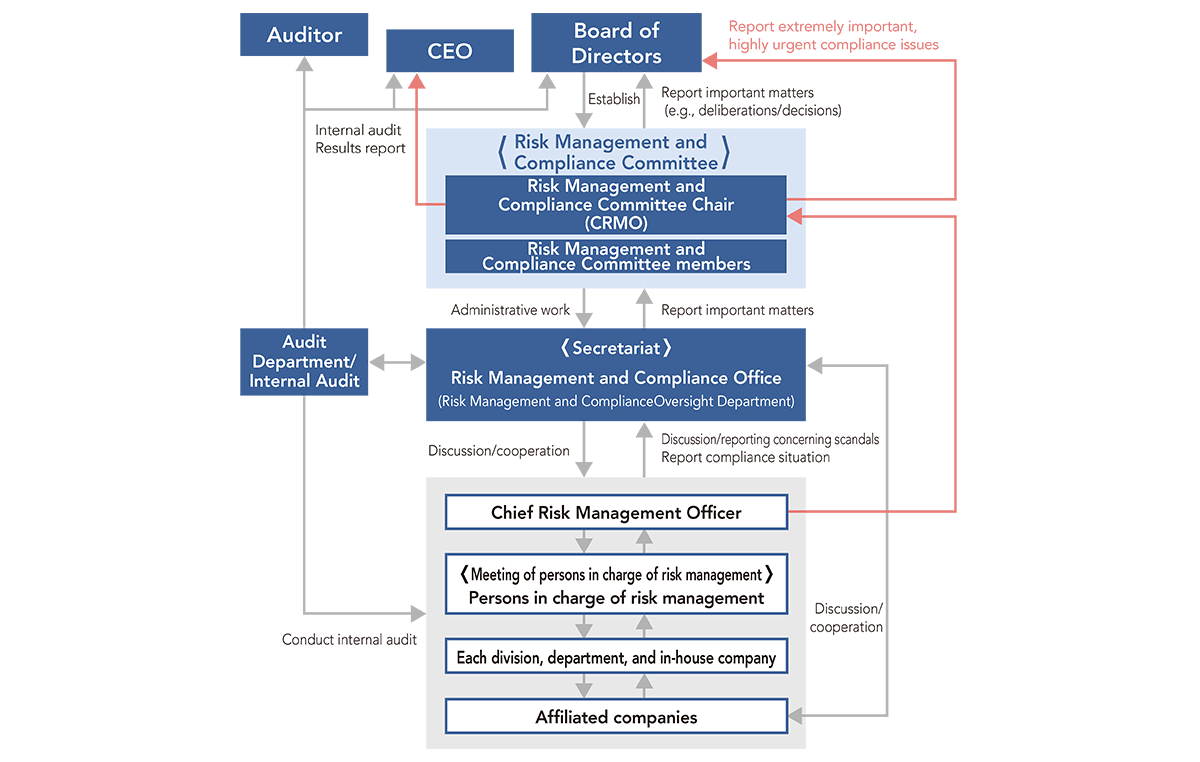
SUBARU has established the Risk Management and Compliance Committee as an organization designed to promote compliance. The Chief Risk Management Officer (CRMO), appointed by the Board of Directors, serves as chair of this committee, with the Governance Risk Management Department*1 serving as its secretariat. Under the chair’s direction and supervision, the committee executes compliance initiatives across the entire SUBARU Group. The committee is responsible for the formulation of various policies, etc., and deliberating on important compliance matters, such as the status of Group-wide compliance activities and the operation of the whistleblowing system, as well as for information exchange and liaison. The content of the committee's activities is submitted to and reported to the Board of Directors, which oversees the Risk Management and Compliance Committee.
We also employ a PDCA cycle, with each department creating its own compliance program each fiscal year to enhance compliance. This involves consistent, structured independent actions for legal compliance management and to foster employee compliance awareness, as well as subsequent verification of compliance status.
Compliance System
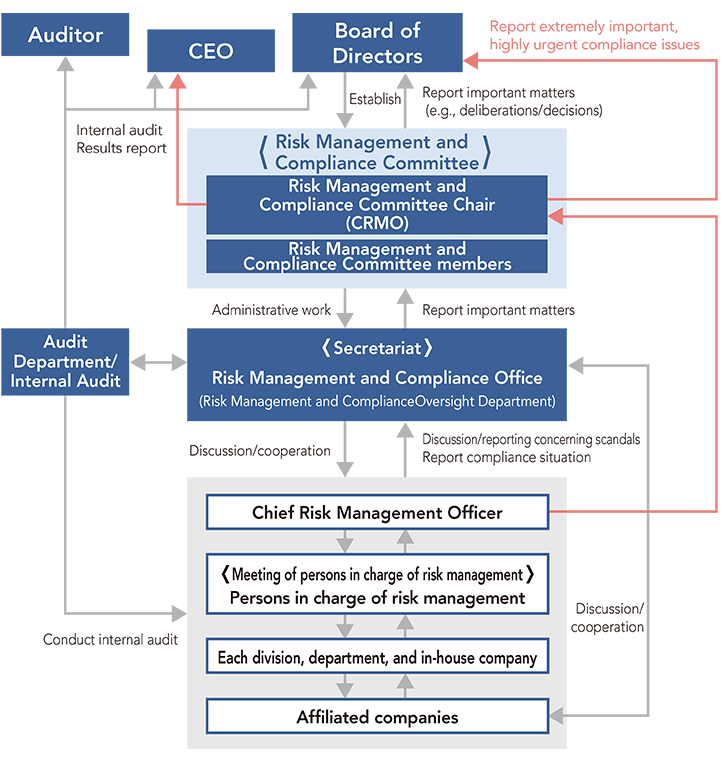
- *1
- As the importance of risk management, compliance, internal controls, and Group governance continues to grow, we have integrated the Risk Management and Compliance Office and the governance promotion functions within the Secretarial Office to manage these areas in a cross-functional and integrated manner and to further strengthen their alignment with management. This integration led to the establishment of the new Governance Risk Management Department in June 2026.
- *2
- All consolidated subsidiaries, and dealerships in Japan
Identified Risks
If serious regulatory violations or fraudulent or inappropriate conduct by officers or employees occur within the SUBARU Group or among its contractors or other associates, this could result in a loss of customer trust and confidence, as well as damage to the brand image due to a decline in public reputation. These outcomes could affect the SUBARU Group’s business foundation and, in turn, have a significant impact on its business performance and financial position. To appropriately address these risks, we are implementing various measures based on our compliance philosophy and policies.
Initiatives
Compliance Hotline (Whistleblowing System)
SUBARU has established the Compliance Hotline to receive reports and consultations, with the aim of promptly detecting and correcting conduct that violates laws and regulations, internal rules, and social norms.
Contact points have been established both internally and externally (the latter with external third-party specialists who have no conflict of interest), allowing officers and employees (including temporary employees) working at SUBARU and its Group companies and dealerships in Japan*1 to submit reports, either using their real names or anonymously, via telephone, the web, or mail; the web portal accepts reports 24 hours a day. Additionally, to ensure accessibility for foreign employees, the hotline supports four languages: English, Chinese, Portuguese, and Spanish.
The hotline ensures the confidentiality and privacy of both the whistleblower and the content of the report. Furthermore, the Company-wide Whistleblowing Rules prohibit retaliation or any other adverse treatment against whistleblowers and those who cooperate with investigations.
In accordance with these regulations, inquiries received through the hotline are carefully reviewed under the supervision of the person responsible for handling reports, who strives to resolve them promptly. Information is also reported to senior management and the Risk Management and Compliance Committee as appropriate. Furthermore, based on the results of analyses of trends in the content of consultations, we implement measures to prevent recurrence, such as planning awareness-raising activities. In addition, we have established a mechanism that enhances the reliability and effectiveness of the hotline through third-party evaluations conducted by attorneys on reported cases and the subsequent actions taken.
To raise awareness of the hotline, we distribute cards to employees containing information on the framework of the system and the contact address for consulting services, and also put up posters in all workplaces. The cards and posters incorporate a message that encourages employees to proactively use the system even for things that feel only slightly suspicious. Through these awareness-raising initiatives, SUBARU has improved awareness of compliance and fostered an atmosphere where employees can more easily consult the hotline, resulting in many consultations received. Since many consultations are interpersonal relationship or labor-related, this system also contributes to corporate culture reforms as a desk for taking up and resolving workplace issues.
In FYE March 2026, we received 315 consultations. Of these, there were 29 suspected violations or violations of compliance, but none of these constituted serious violations. In addition, four of the 29 consultations involved conduct that was identified as harassment, such as abuse of power, but there were no cases of violations of the Labor Standards Act. Although these cases did not constitute serious compliance violations, we confirmed the facts of the major cases and took corrective measures such as alerting the relevant parties and re-educating them on procedures and rules.
We have also established whistleblowing systems at our consolidated subsidiaries outside Japan in accordance with laws, regulations, and conditions in each country and region.
In addition, we have established a separate consultation service for customer opinions and consultations regarding our products and services, as well as inquiries from our business partners. Please see the “Contact for Opinions and Consultation Services (Remediation Mechanism)” section of “Respect for Human Rights” for more information.
- *1
- Excludes some dealerships in which SUBARU holds no equity interest
Compliance Hotline (Consultation and Resolution Procedure)
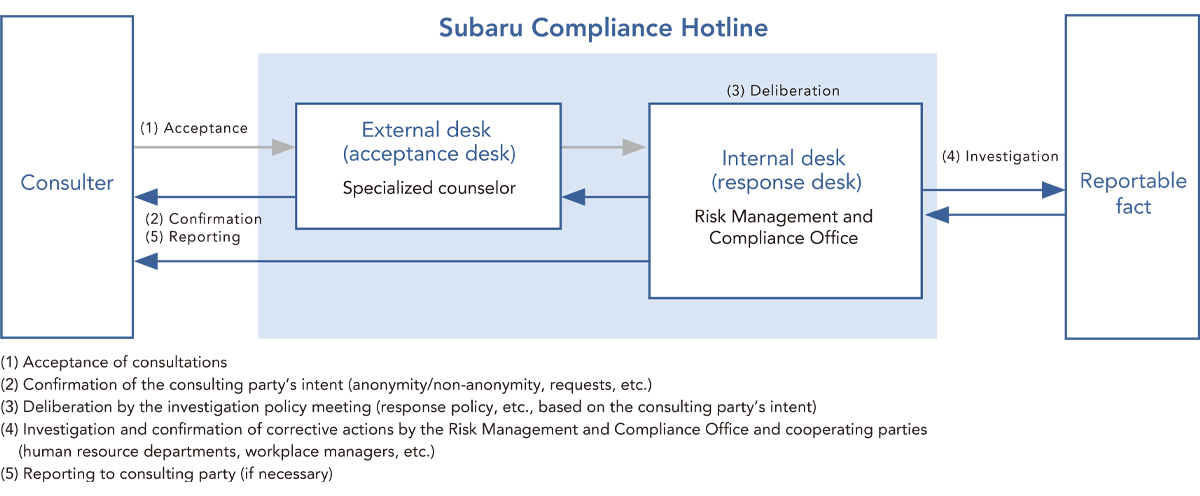
Breakdown of Compliance Hotline Consultations

- Scope:
- SUBARU and its Group companies and dealerships in Japan*1
- *1
- Excludes some dealerships in which SUBARU holds no equity interest
Training and Awareness-Raising
Training
In enforcing thorough compliance, we believe that initiatives in which the entire SUBARU Group acts in concert are necessary. We conduct compliance training, training for legal affairs in practical business, and other programs for employees of SUBARU and its Group companies and dealerships in Japan organized by our Legal Department, Governance Risk Management Department and human resource and education departments.
In FYE March 2026, SUBARU conducted compliance training for new employees, skilled employees, and those of associate manager level and above at the Aerospace Company.
In addition, to promote the understanding of key laws and regulations, the Legal Department leads training for legal affairs in practical business for SUBARU and its Group companies and dealerships in Japan. In FYE March 2026, we conducted such training within 10 programs covering topics that included security export controls, personal information protection laws in various countries, Japan’s SME Transactions Act, and anti-monopoly laws outside Japan.
Furthermore, SUBARU and its Group companies and dealerships in Japan hold their own study groups, covering topics such as security export control, the Act on the Protection of Personal Information, the Antimonopoly Act, the Political Funds Control Act, and harassment prevention.
Awareness-Raising
We regularly disseminate information to employees at SUBARU and its Group companies and dealerships in Japan with the aim of making compliance feel more accessible and fostering awareness of it in their daily work.
In addition, SUBARU designates October of each year as Compliance Month, during which the CRMO issues a message. In FYE March 2026, the CRMO’s message to the entire SUBARU Group provided an opportunity for each employee to reflect anew on what compliance means.
Furthermore, we are working to disseminate highly urgent information promptly and alert employees of SUBARU and its Group companies in Japan to such matters.
Bribery Prevention
At SUBARU, we consider the prevention of bribery as an important issue, and we have therefore established Company-wide Bribery Prevention Rules, which we post to our intranet and disseminate to employees.
We have also established the following standards of conduct in the Compliance Guidelines, which are implemented across all Group companies and dealerships in Japan. We are committed to ensuring that specific actions are rigorously communicated and enforced through the Compliance Manual.
- Prohibition of providing, offering, or promising improper entertainment, gifts, favors, or other economic benefits to public officials or persons in similar positions, whether in Japan or abroad
- Prohibition of providing or receiving an amount in excess of socially accepted norms in dealings with business partners and customers who do not constitute public officials or similar persons
- Prohibition of receipt of personal gain as a result of using information obtained in the course of business, establishing boundaries between public and private life
To supplement the Compliance Guidelines and Group-wide Risk Management and Compliance Rules, SUBARU’s Company-wide Bribery Prevention Rules clarify prohibited and non-prohibited acts when dealing with public officials. SUBARU’s consolidated subsidiaries outside Japan have also established guidelines on anti-bribery in consideration of local laws and regulations to clarify the conduct required of employees and executives. In China, taking into consideration unique social conditions, we created the Bribery Prevention Guidelines (with a Chinese translation included). It is distributed throughout our Chinese subsidiaries and forms the official rules of each company.
Also, in the Compliance Manual (available in Japanese, English, and Chinese) issued to Group companies and dealerships in Japan and consolidated subsidiaries outside Japan, we not only require proper conduct regarding bribery to public officials but also pursue thorough fairness in transactions with private-sector business partners.
SUBARU requests that our suppliers thoroughly comply with the SUBARU Supplier CSR Guidelines’ clearly-stated policy for preventing corruption.
Under the monitoring system for bribery prevention, SUBARU conducts Company-wide fact-finding investigations to collect information for ascertaining the presence of cases that may constitute compliance violations. We also strive to detect cases early via business audits conducted by internal audit departments. To strengthen oversight, high-risk cases are reported to the Risk Management and Compliance Committee and the Board of Directors.
In FYE March 2026, there were no fines, penalties, or settlement payments related to violations of anti-corruption laws and regulations within the SUBARU Group, and no individuals were subject to disciplinary dismissals for such violations.
Political Donations
With regard to donations related to political activities, SUBARU complies with the Political Funds Control Act, the Public Offices Election Act, and other relevant laws and regulations. To ensure the proper operation and execution of such donations, SUBARU has established the Political Funding Company-wide Rules and strives to maintain social trust through compliance with these rules. These rules stipulate that donations may only be made to political parties or political funding organizations.
- Note:
- Donations in FYE March 2026: 17 million yen to the People’s Political Association
Personal Information Protection Initiatives
The SUBARU Group complies with personal data protection regulations in various countries and regions, including Japan’s Act on the Protection of Personal Information and the EU General Data Protection Regulation (GDPR). To ensure the lawful and appropriate handling of personal information, the Group has established systems, a privacy policy, and management regulations.
In this system, the executive officer in charge of the Legal Department serves as the chief privacy officer and oversees SUBARU’s personal information protection activities. This executive officer chairs the Personal Information Protection Committee, which is composed of executive officers responsible for relevant departments. At SUBARU, this committee meets at least once a year, where it reviews SUBARU’s personal information protection activities, promoting the PDCA cycle in these activities.
Under this framework, SUBARU continues its efforts to ensure the appropriate handling of personal information.
In FYE March 2026, we conducted training on Japan’s Act on the Protection of Personal Information for SUBARU and its Group companies and dealerships in Japan. We also provided training on compliance with personal information protection regulations outside Japan for SUBARU and its Group companies in Japan. Furthermore, we verify the management status of personal information handling at SUBARU and its dealerships, including that of contractors within Japan. We also check compliance with relevant regulations across all SUBARU departments and the handling of personal information subject to data protection regulations outside Japan. Improvements are being implemented as necessary based on the results of these verifications.
Security Export Control
SUBARU, seeking to preserve the peace and safety of the international community, has established the Company-wide Security Export Control Rules to appropriately implement export control. In accordance with the Foreign Exchange and Foreign Trade Act, SUBARU enforces strict export control to ensure that consumer products and technology that could be repurposed for military use, including weaponry, do not fall into the hands of countries developing weapons of mass destruction or terrorists (non-state entities).
The Company-wide Security Export Control Rules establish the following as basic policies:
- With regard to the export of regulated goods, intermediary trade transactions, and intermediary transactions of technology, we will not engage in any conduct that violates export-related laws and regulations, including the Foreign Exchange and Foreign Trade Act.
- To comply with export-related laws and regulations and implement appropriate export control, we will designate a manager responsible for export control to clarify the locus of such responsibility and promote the development and enhancement of the export control system.
SUBARU has assigned overall responsibility for export control to the executive officer in charge of the Legal Department and has established an Export Control Committee chaired by that executive officer. The Export Control Committee consists of the executive officers responsible for each of the export-related departments and meets at least once a year.
At the chair’s direction, the committee deliberates on important matters related to export control, receives audit reports, and reviews the amendment or abolition of regulations; the results of these deliberations are reported to the Board of Directors as necessary.
Under this framework, we implemented the following initiatives in FYE March 2026 to ensure the proper operation of export control.
Training Programs
Training on export control:
- Training conducted by external experts for members of the Export Control Committee and export control managers in each department (once a year)
- Training conducted by the Legal Department for practitioners (twice a year)
- Training for managers in the Aerospace Company (twice a year)
Training on export control IT systems:
- Training to promote understanding of the relationship between export control IT systems and internal rules (once a year)
Audits
We have established a framework comprising self-audits by export-related departments, second-tier audits by the Legal Department, and third-tier audits by the Internal Audit Department and other units, with the aim of maintaining and improving management standards.
Furthermore, we are expanding our deemed export control management in departments that handle sensitive technologies to confirm compliance with the U.S. Export Administration Regulations and to ensure proper management.
Tax Initiatives
In June 2020, the SUBARU Group enacted its Tax Policy that defines our posture and way of thinking toward tax laws as a basic policy for paying appropriate taxes.
The Chief Financial Officer (CFO) has primary responsibility for tax governance, and SUBARU’s Finance & Accounting Department provides appropriate support to ensure that each department of the SUBARU Group can implement tax governance appropriately.
In promoting tax strategy and risk management, SUBARU’s Finance & Accounting Department reports on these matters to the CFO, who must approve them before submission to SUBARU’s Executive Management Board Meeting and the Board of Directors. Such matters are also reported to the accounting auditors during their audits upon request as appropriate.
SUBARU received a “Good” rating from the National Tax Agency for the agency’s administrative year from July 1, 2023 to June 30, 2024 in relation to efforts to promote the enhancement of corporate governance on tax matters*1.
- *1
- Regarding the National Tax Agency’s policies for efforts to promote the enhancement of corporate governance on tax matters (Japanese version only):
https://www.nta.go.jp/taxes/tetsuzuki/shinsei/shinkoku/hojin/sanko/cg.htm
Tax Policy
The SUBARU Group is able to conduct its business operations thanks to support from society, and it strongly recognizes the importance of returning profits to society. The SUBARU Group considers fulfilling its tax obligations to be an essential element of this.
The SUBARU Group strives to ensure compliance with the tax laws and regulations of each country and jurisdiction, pursuant to the international rules and standards set out by international organizations, thereby fulfilling its social obligations through appropriate tax payment, while aiming for sustainable growth through sound business activities.
1. Compliance with Tax Laws and Tax-Related Regulations
The SUBARU Group undertakes applicable tax return filing and tax payment procedures in compliance with the tax laws and tax-related regulations of each country, and relevant tax treaties.
2. Tax Corporate Governance
The SUBARU Group establishes and implements a structure to appropriately identify, manage and report tax risk. In order to respond to changes in its businesses, and in light of complex tax operations, the SUBARU Group enhances this structure by assigning to it employees with tax expertise. Furthermore, the SUBARU Group raises awareness and provides guidance and consultation regarding tax compliance to SUBARU Group companies, making use of external professionals, and properly fulfills its tax payment obligations.
3. Appropriate Intercompany Transaction Prices (Transfer Pricing)
The SUBARU Group conducts inter-group transactions and transactions with unrelated parties applying economically rational (arm’s length) prices, and does not inappropriately set prices through arbitrary manipulation.
4. Compliance with Anti-Tax Haven Rules
The SUBARU Group does not establish entities that are unnecessary for its business with the aim of tax avoidance, and the SUBARU Group pays taxes pursuant to the substance of its businesses in accordance with the tax laws and regulations.
5. Relationship with Tax Authorities
The SUBARU Group strives to maintain trust with tax authorities by dealing with the authorities in a good faith manner; for example, by providing fact-based information in an appropriate and timely manner in response to requests.
Established in June 2020