
Human Resources: Human Resource Development
Our Approach
Approach to Human Capital Management: Our Approach
To realize SUBARU’s ideal state of “truly competitive people and organization,” we are promoting human capital management initiatives based on individual growth and organizational growth.
Management System
Approach to Human Capital Management: Management System
SUBARU promotes human capital management under the leadership of the Chief Human Resources Officer (CHRO). The CHRO is responsible for a wide range of areas that contribute to maximizing human capital, including human resource development, diversity, equity and inclusion, work-life balance, health management, and labor-management communication.
Initiatives
At SUBARU, we have established a system that encourages employees to take on challenges and grow by integrating evaluation, compensation, and development into a unified, cyclical process.
Job Categories, Evaluation, and Compensation
SUBARU’s human resources system establishes two job categories: core positions, which form the backbone of the organization and are compensated based on role and performance; and specialist positions, in which employees demonstrate their ability to perform duties based on their expertise. However, the basic framework for evaluation and compensation is common to both job categories.
Approach to Job Categories, Evaluation, and Compensation
| Description | ||
|---|---|---|
| Job Categories | Core Positions | A role-based grading system determines grades based on the role (mission) and the scale of results delivered. Emphasizes the difficulty of the role and accountability for results, rather than experience or age |
| Specialist Positions |
A competency-based qualification system determines qualifications based on expertise and job performance capabilities. Emphasizes work experience and depth of skills, with evaluation criteria focused on ensuring SQCDM*1 on the front lines and demonstrating professional expertise |
|
| Evaluation |
|
|
| Compensation | Evaluation results are reflected in basic salary (pay raises) and bonuses | |
- *1
- Safety, Quality, Cost, Delivery, Man
Training
Initiatives Led by the Human Resources Department
At SUBARU, we have established training programs based on the concepts of individual growth and organizational growth, which serve as the foundation of our human capital management.
Furthermore, at our consolidated subsidiaries in Japan (excluding dealerships), we are taking development actions through training and exchanges across the Group based on the concept of shared Group human resource development. For major training programs organized by the Human Resources Department in FYE March 2026, the average training hours per employee was 4.3, the average training cost per employee was 33,000 yen, and the total training hours was 252,909 (in addition to these, each department plans and operates its own training for its employees to acquire the knowledge and skills required for work).
Starting in FYE March 2027, we are reviewing certain aspects of our human resource development programs to rapidly achieve “truly competitive people and organization.” We aim to maximize the potential of both individuals and the organization by enabling each employee to learn autonomously and demonstrate leadership in their respective roles through practical application.
Structure of Training Programs
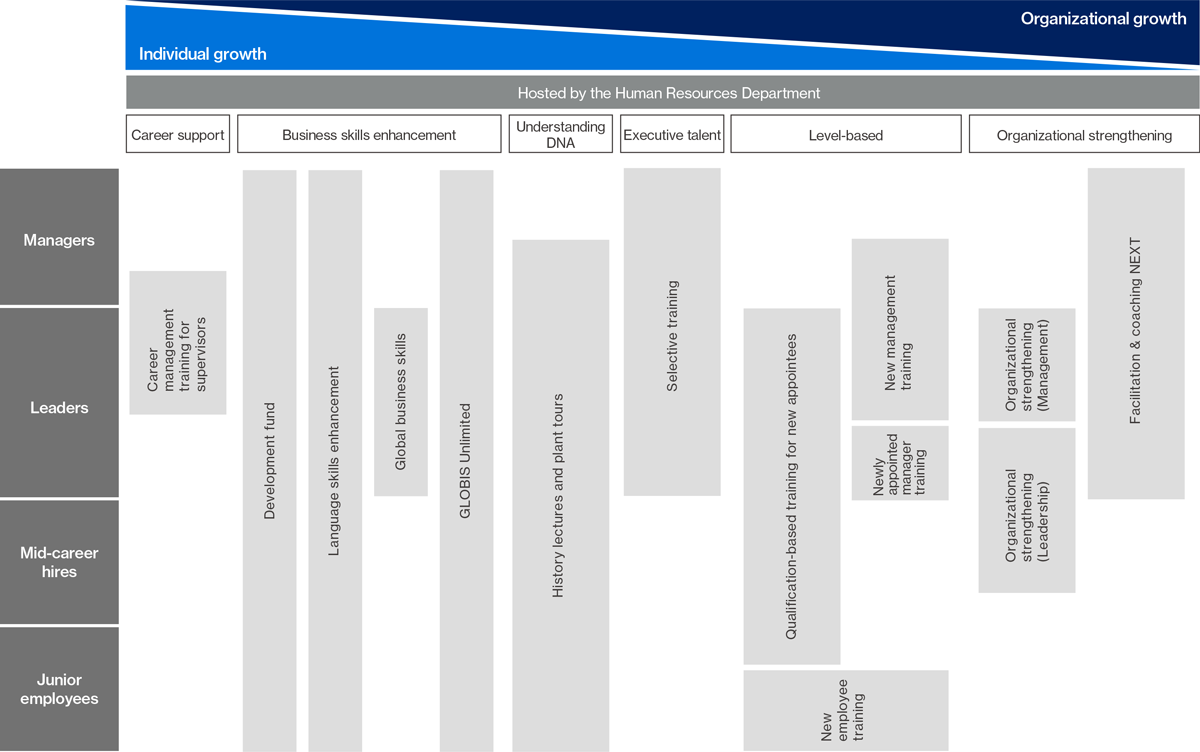
Training Programs
| Description | ||
|---|---|---|
| Programs Led by the Human Resources Department | Career Support |
|
| Strengthening Business Skills |
|
|
| Understanding SUBARU’s DNA | Promotion of understanding SUBARU’s DNA through onboarding programs, including history lectures and plant tours | |
| Executive Talent | Continuation of selective training programs for managers and leaders with the aim of fostering the next generation of executive talent | |
| Rank-Specific Programs | Systematic acquisition of roles, mindsets, and skills through rank-specific training | |
| Enhancing Organizational Capabilities | Promotion of cross-functional collaboration through facilitation and coaching training (all managers have completed the program) | |
Support for Earning Degrees
At SUBARU, we support each employee in taking the initiative to learn and continuously enhance their expertise. As part of this effort, we have established a system designed to help employees pursuing graduate degrees balance their academic studies with their work. SUBARU views this program as an investment in human capital that leads to accelerated technological innovation and improved problem-solving capabilities. As of March 2026, three employees are utilizing this program to pursue graduate degrees.
Digital Human Resource Development
[IT Academy: IT and Digital Training for All Employees]
SUBARU operates the IT Academy, a talent development mechanism designed to enhance the IT and digital skills of all employees. The IT Academy provides opportunities for every employee—from beginners to advanced users—to systematically acquire IT knowledge and skills tailored to their individual level and role. We are simultaneously working to raise the overall level of IT literacy across SUBARU and to develop “smart employees*1” who can apply IT and digital skills in their work, thereby promoting day-to-day operational improvements and business transformation through the use of IT and data. This training is available to regular employees, temporary employees, and employees seconded to SUBARU and its consolidated subsidiaries in Japan, including dealerships. In addition, during FYE March 2026, we expanded this training to include directors and executive officers.
- *1
- Employees who possess IT and digital skills and can apply them to their work
[Developing Technical Talent with Expertise in Both Vehicles and Software]
In FYE March 2023, SUBARU launched an in-house initiative called the Software Human Resource Development Project with the goal of developing talent capable of understanding and developing both vehicles and software. Under this project, we provide training tailored to the levels and roles of all employees in engineering units. This training consists of three tiers: intensive training for new employees, upskilling training for existing employees, and training for management. For new hires and existing employees, we have established the Embedded Systems Course and the AI/DX Course at three levels—beginner, intermediate, and advanced—creating a system where participants can take courses according to their proficiency level. Over the four-year period from FYE March 2023 to FYE March 2026, the cumulative number of participants was 754 in the Embedded Systems field (including 243 at the intermediate level or higher) and 1,308 in the AI/DX field (including 444 at the intermediate level or higher).
Participants are applying the skills they have learned to actual development tasks, such as predicting battery degradation and fuel efficiency. Going forward, we will expand the training methods accumulated in engineering departments to other departments to further expand our pool of software talent.
Skill Transfer in the Manufacturing Domain
[Training for New Hires]
Newly hired employees in manufacturing departments, regardless of their employment status, are provided with two-week introductory training at the SUBARU Training Center. They learn the rules of the manufacturing floor, basic skills, and specialized skills for their assigned departments through a shift-based training system, with the goal of helping them adapt to the workplace as quickly as possible.
[Technician Development*1]
In technician development, we aim to develop talent capable of autonomously solving problems from an SQCDM*2 perspective and conduct education based on five core areas of introduction, basics, skills, improvement, and management. In addition, to pass on skills that require human intuition, we offer a program called the Special Skills Transfer Course.
- *1
- Employees who leverage specialized skills and experience to perform field work in manufacturing processes
- *2
- Safety, Quality, Cost, Delivery, Man
[Human Resource Development through the National Skills Competition]
Through its ongoing participation in the National Skills Competition, SUBARU is committed to developing technicians who possess advanced technical skills and have the potential to become future leaders.
The National Skills Competition is a contest aimed at young technicians up to 23 years old, designed to improve their skills and promote public understanding of the importance of skilled labor. It serves as a venue where technicians selected from across the country compete to demonstrate their skills. The competition categories cover a wide range of occupations, including manufacturing, construction, and the service sector.
SUBARU selects and trains young employees in their first three years of employment as competitors, and they participate in the National Skills Competition every year in categories such as lathe work, plastic molding, and automobile sheet metal. Selected competitors spend approximately three years after joining the Company training for this national competition, striving every day to hone their skills, concentration, and endurance to ensure they can do their best during the event.
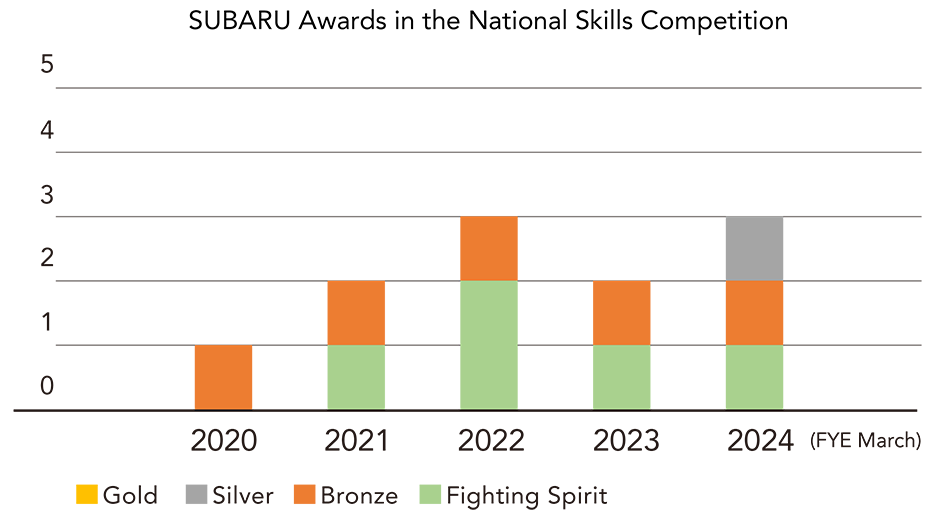
At the 63rd National Skills Competition in 2025, SUBARU placed in all three events, winning a Silver Award in plastic molding and receiving the Fighting Spirit Award in lathe work and automobile sheet metal.
SUBARU Awards in the National Skills Competition
- Note:
- Our cumulative record to date is 1 Gold Award (2017), 5 Silver Awards, 14 Bronze Awards, and 42 Fighting Spirit Awards.