Respect for Human Rights
Our Approach
Establishment of the Human Rights Policy
The SUBARU Group puts people first and engages in people-oriented manufacturing. Based on the belief that respect for the rights and characteristics of individuals is an important management issue for SUBARU, the SUBARU Group established its Human Rights Policy in April 2020. This policy respects and aligns with the human rights stipulated in international norms such as the Universal Declaration of Human Rights (UDHR), International Covenants on Human Rights, and the ILO Declaration on Fundamental Principles and Rights at Work. This Human Rights Policy applies to SUBARU and all its subsidiaries and covers all stakeholders, including business partners. It prohibits any discrimination based on race, age, sex, gender identity or expression, sexual orientation, national origin, ethnicity, place of origin, religion, creed, profession, disability, family relations, or any other status protected by applicable law.
This policy was formulated in consideration of stakeholder expectations through discussions with outside experts and subsidiaries outside Japan, and was established after being reported to the Board of Directors in March 2020. The policy’s appendix, which identifies priority human rights issues from the perspective of the SUBARU Group’s business, will be reviewed as appropriate based on changes in social demands, including laws and regulations, technological advances, and the SUBARU Group’s business operations.
Human Rights Policy
Principle of Respect for Human Rights
The SUBARU Group, through its automotive and aerospace businesses, puts people first and engages in people-oriented manufacturing.
Respect for the rights and characteristics of individuals is an important management issue for SUBARU. Based on this policy, the SUBARU Group clarifies its responsibilities to respect human rights based on the United Nations Guiding Principles on Business and Human Rights.
1. Compliance with Laws and Regulations to Respect Human Rights
(Scope and Management Structure)
- This policy applies to the SUBARU Group worldwide―SUBARU CORPORATION and its all subsidiaries, expects and encourages our business partners and other stakeholders associated with our operations, including those in the supply chain, to respect human rights in accordance with this policy. To realize these goals, we have appointed Representative Director, President and CEO as a director who is responsible for leading the process of developing this policy and assigning resources as needed for its implementation and continued improvement.
(Related Laws and International Norms)
- We will comply with the relevant laws and regulations of each country, and respect the human rights stipulated in international norms such as The Universal Declaration of Human Rights (UDHR), International Covenants on Human Rights (International Covenant on Economic, Social and Cultural Rights, and International Covenant on Civil and Political Rights), and the ILO Declaration on Fundamental Principles and Rights at Work. If the standards set forth in the international norms exceed those set forth in applicable law, we will aim to adhere to the international norms.
2. Implementation of Human Rights Due Diligence
(Response to Human Rights Risks)
- We will identify potential or actual human rights risks linked to our business and establish and continuously operate mechanisms to prevent or mitigate such risks.
(Corrective Actions)
- We will strive to remedy any adverse human rights impact that we have caused or are involved in. We will also establish and maintain our grievance mechanism to do so.
(Training)
- To ensure that this policy is understood and practiced by all the members of the SUBARU Group, we conduct regular training and awareness-raising programs for executives, employees, and other stakeholders to respect human rights.
(Dialogue and Consultation)
- We engage in dialogue and consultation with relevant stakeholders in order to improve our commitment to respect for human rights.
(Information Disclosure)
- We will annually report on our commitments and the actions we have taken to respect and promote human rights pursuant to this policy.
Revised in March 2022
Human Rights Policy Appendix
Priority Human Rights Issues in SUBARU Group’s Businesses
The SUBARU Group’s manufacturing is supported not only by our own factories, but also by an extremely large number of people working in the multilayered supply chains. We also have contact with a variety of people in areas such as marketing, sales, and after-sales service through distributors and dealers all over the world. We provide products and services through our businesses that value the many irreplaceable lives. In order to respect human rights, and the numerous irreplaceable lives of all those involved in the SUBARU Group, we will actively address the following as priority issues identified so far.
We will regularly review the priority issues in this Appendix based on changes in social demands, including laws and regulations, technical progress, and the business operations of the SUBARU Group.
(Respect for Rights to Human Life and Property)
- In order to protect the basic rights of people and their families who interact with SUBARU Group’s products and services, such as drivers, passengers, and pedestrians, we aim to eliminate all traffic accident deaths that involve SUBARU vehicles.
- We will promote the humanitarian use of the SUBARU Group’s various products and services, including disaster relief, and strive to avoid inhumane use.
(Respect for Individuals, Diversity and Inclusion)
- We value the unique characteristics of our employees, our business partners, and the members of the communities in which we operate and strive to create an environment of diversity and inclusion.
- We will conduct our business activities with full respect for privacy, including protecting the personal information of not only our customers and employees, but also those involved with the SUBARU Group.
(Zero Tolerance for Discrimination and Harassment)
- We do not tolerate any discrimination based on race, age, sex, gender identification or expression, sexual orientation, national origin or place of origin, ethnicity, religion, creed, profession, disability, family relations, or any other status protected by applicable law among all persons involved in the SUBARU Group. Moreover, we do not tolerate any harassment that harms human dignity.
- We will carefully consider potential human rights risks in our marketing and other communication activities, and do not tolerate expressions that are discriminatory or may adversely affect children.
(Respect for the Workers’ Rights in SUBARU Group and Encouraging Our Supply Chains)
- We do not tolerate child labor, forced labor, slave labor, and human trafficking.
- We do not expose young workers to hazardous work.
- We will give due consideration to the human rights of foreign workers and migrant workers.
- We respect freedom of association and the right to collective bargaining, which are fundamental workers’ rights. We are committed to engagement with employees to ensure a positive working environment.
- We will maintain a worthwhile, safe, and hygienic working environment.
- In order to promote the well-being of workers, we will pay appropriate wages more than the minimum and living wages, and manage working hours appropriately.
- We expect and encourage our supply chains to respect the rights of workers.
(Respect for the Rights of Vulnerable People in Local Communities)
- We engage in responsible procurement practices including those related to conflict minerals.
- We will give special consideration to respect for the human rights of women, children, people with disabilities, social minorities, ethnic minorities, indigenous peoples, and other vulnerable groups.
(Contributions to Respect for Human Rights)
- We will actively contribute to human rights protection worldwide through the SUBARU Group’s corporate citizenship activities.
Established in April 2020
Management System
The SUBARU Group has established a structure in which the Representative Director, President and CEO is responsible for human rights within the Group. We have formed a task team comprising management personnel from the Governance Risk Management Department, Human Resources & General Administration Division, Investor Relations Department, Sustainability Promotion Department, Monozukuri Division, Purchasing Division, and the Aerospace Company (procurement department)*1. The team regularly examines human rights issues and countermeasures and promotes improvements based on the plan-do-check-act (PDCA) cycle. The matters examined by the task team are reported once a year to the Sustainability Committee, chaired by the Representative Director, President and CEO.
- *1
- The activity details are based on FYE March 2026 results. Organization names are as of publication (FYE March 2027).
Promotion System for Respect for Human Rights
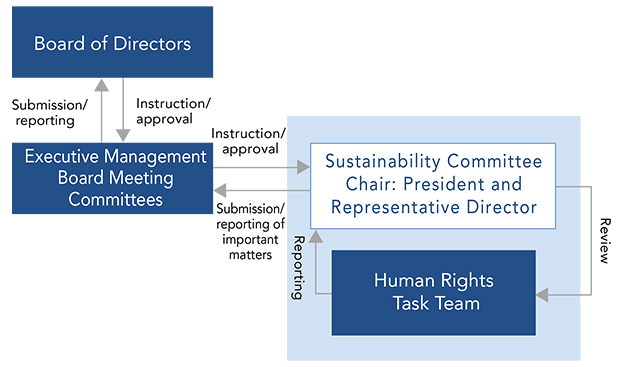

Reports and discussions related to human rights in the Sustainability Committee and the Board of Directors
| FYE March | Description |
|---|---|
| 2026 | Progress on measures addressing human rights risks and additional measures based on monitoring results |
For specific human rights risks and measures implemented in FYE March 2026, please see Initiatives.
Identified Risks
If labor environment or occupational health and safety issues, various forms of harassment, infringements of workers’ rights or opportunities, procurement involving human rights concerns, or similar problems arise within the SUBARU Group or among its related parties, they may result in violations of applicable laws and regulations, loss of customer trust and confidence, damage to brand image resulting from a decline in social reputation, sluggish sales, talent outflow, and difficulties in procuring materials and funding. These impacts could undermine the Group’s business foundation and have a significant effect on its business performance and financial position.
We are implementing various initiatives to appropriately address these risks.
Initiatives
Activities to Raise Awareness of Human Rights
Each year, SUBARU holds seminars and implements measures to encourage understanding of business and human rights. In FYE March 2026, in conjunction with Human Rights Week in December, SUBARU published a human rights-themed issue of the Sustainability Newsletter, our online in-house newsletter. During No Workplace Harassment Month, also held in December, SUBARU provided training to managers on the subject of harassment.
We also raise awareness of human rights initiatives among our suppliers through measures such as procurement policy briefings and business partner CSR briefings.
Seminars on Business and Human Rights/Measures to Encourage Understanding
| Eligible Participants | Description | |
|---|---|---|
| FYE March 2026 | All SUBARU employees and Group companies in Japan | Publication of a human rights-themed issue of the in-house Sustainability Newsletter |
| SUBARU managers | Harassment training |
Stakeholder Engagement
At the SUBARU Group, to understand and respond to stakeholder expectations related to human rights, we hold discussions with experts and communicate with suppliers, institutional investors, and external assessment organizations.
In FYE March 2026, we met with multiple institutional investors in Japan and overseas to explain SUBARU’s perspective and specific initiatives regarding human rights. Institutional investors expressed positive expectations for further initiatives by the SUBARU Group, such as broader efforts to identify potential risks, including within our supply chain. We also worked to eliminate human rights violations through measures including mutual dialogue with suppliers and expansion of CSR surveys further along the supply chain.
We also actively shared the latest information on our initiatives to external evaluating organizations, and expectations and suggestions raised by each organization are reported to the Sustainability Committee and shared among all executives.
Human Rights Due Diligence
The SUBARU Group carries out human rights due diligence in consideration of international frameworks such as the United Nations Guiding Principles on Business and Human Rights and the OECD Due Diligence Guidance. Beginning in FYE March 2021, we identified anticipated risks and formulated measures in the human resources and procurement domains, and subsequently proceeded to verify and monitor those measures. All risks and measures identified in the human resources and procurement domains from FYE March 2021 through FYE March 2022, as well as measures formulated in FYE March 2024 and FYE March 2025 to address risks particularly in the manufacturing domain (Automotive Business) within the human resources domain, have been reviewed by LRQA Limited (https://www.lrqa.com/), an organization with specialized knowledge on business and human rights.
Identified Risks and Corresponding Measures
| Field | Human Rights Risks | Key Measures in FYE March 2026 | |
|---|---|---|---|
| Human Resources Domain | Long working hours, infringement of the rights of vulnerable people in local communities (including women and sexual minorities), harassment of workers, industrial accidents, forced labor among foreign workers, forced labor including among on-site contractors on our premises, infringement of workers’ rights and opportunities | Human Resources Domain | Trial program for non-Japanese leaders, labor management training, promotion of activities by LGBTQ+ allies, harassment training, education and information sharing to prevent the recurrence of industrial accidents |
| Manufacturing Domain (Automotive Business) |
Unified standards were established for warning signs throughout the Gunma Plant, including new signs that are easy to understand regardless of nationality. Conducted human rights risk surveys among on-site contractors on our premises, with stronger monitoring of these contractors |
||
| Procurement Domain | Responsible mineral procurement (e.g., conflict minerals and cobalt), human rights violations among suppliers, harassment of suppliers | Continued implementation of responsible mineral procurement surveys for suppliers (in addition to existing conflict mineral surveys, mica surveys were newly added and cobalt survey items were expanded in FYE March 2025), implementation of Supplier CSR Surveys, and implementation of compliance and awareness-raising measures regarding the amended Proper Transactions Act | |
Implementation and Monitoring of Measures
The Human Rights Task Team reviews the measures developed for each risk and the progress made by the departments responsible for each field. By periodically reporting the findings to the Sustainability Committee and the Board of Directors, we will continue monitoring and mitigating risks. For measures in the procurement domain, we collaborate with our suppliers to advance initiatives based on the SUBARU Supplier CSR Guidelines.
Contact for Opinions and Consultation Services (Remediation Mechanism)
The SUBARU Group has established a system through which voices from a range of stakeholders reach the Company via its contact points.
Diverse inquiries, feedback, and grievances, including those pertaining to human rights, are handled appropriately through the respective channels and lead to corrective or remedial action as necessary. We ensure the anonymity of those seeking consultation and the confidentiality of their consultations. There shall be absolutely no retaliation for any kind of complaint that may be made through this system.
For Employees
We maintain a Harassment Advice Line and Compliance Hotline internally and externally, creating an environment in which all employees of SUBARU and its Group companies and dealerships in Japan*1 can receive advice. In particular, the Compliance Hotline provides consultation services in four languages (English, Chinese, Portuguese, and Spanish). We also introduced confidential online consultations in October 2022.
- *1
- Excludes some dealerships in which SUBARU holds no equity interest
For Customers
SUBARU Customer Center: SUBARU Call has been established as a system for promptly sharing information on customer opinions and comments with relevant departments and utilizing this information to make improvements.
We respond to inquiries about products and services as well as various other opinions and concerns. If requested by the customer, we treat the matter as confidential, and we share the feedback received with the relevant departments in an effort to resolve matters.
SUBARU Call (Japanese version only)
For Suppliers
At SUBARU, we are taking actions to promote fair trade based on the Automobile Industry Fair Trade Guidelines. As part of this effort, we have established a consultation service for promoting fair trade for suppliers in SUBARU’s supply chain, with the aim of early detection, prevention, corrective measures, and preventing recurrence of compliance issues, to maintain a healthy supply chain and build the best possible partnerships with our suppliers.
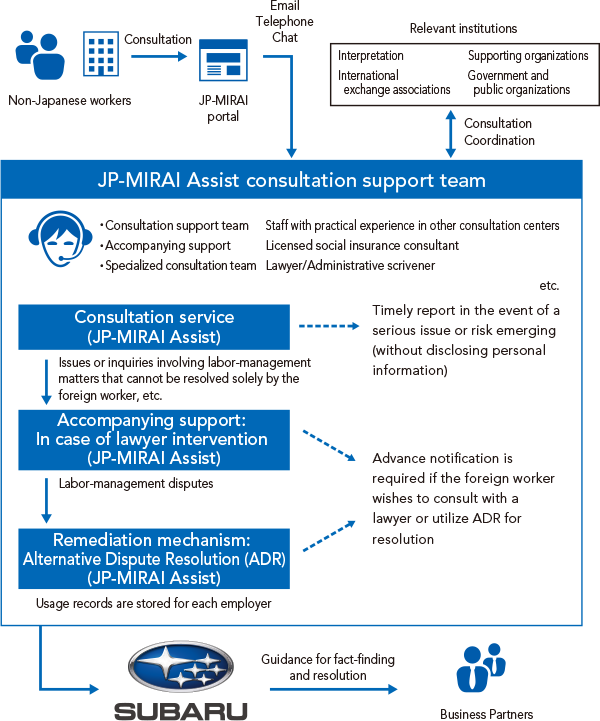
In FYE March 2023, we endorsed and joined the supply chain human rights initiative, Japan Platform for Migrant Workers towards Responsible and Inclusive Society (JP-MIRAI). We are also encouraging suppliers that supply direct materials (parts and raw materials) to participate alongside us in the Collaborative Program for Companies Responsibly Hosting Foreign Migrant Workers, which became fully operational in FYE March 2024.
We provide support in 23 languages*1 for the consultation service, the area of the program that SUBARU is involved in. This service is available not only for non-Japanese but also Japanese workers employed by suppliers. The consultation service covers a wide range of topics, from gathering information about daily life in Japan to addressing concerns related to human rights and labor issues. For matters that cannot be resolved through the consultation service, we provide accompanying support through consultations with specialists such as lawyers, or utilize the Tokyo Bar Association’s Alternative Dispute Resolution (ADR) for added assistance. This ensures a fair and transparent approach through third-party involvement. In addition to the consultation service, we offer a portal site that compiles various information for foreign workers, available as a smartphone app, making it accessible to anyone with ease. We promote awareness of the consultation service for workers by distributing flyers with QR codes to suppliers and organizing briefings to explain the usage process.
The overall program, including the consultation service, has been developed by taking into account feedback and input from companies (including SUBARU) and stakeholders (including suppliers) that participated in the pilot project.
- *1
- Easy Japanese, English, Chinese, Korean, Thai, Vietnamese, Indonesian, Malay, Tagalog, Nepali, Myanmar, Khmer, Mongolian, Sinhalese, Hindi, Bengali, Portuguese, Spanish, German, French, Italian, Russian, and Urdu
JP-MIRAI Consultation Service