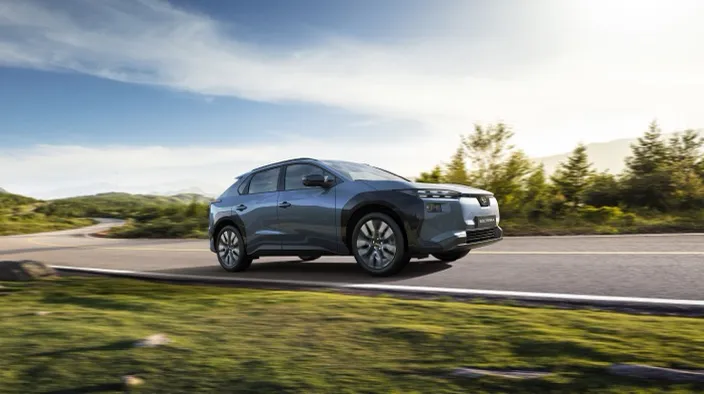
With the automotive industry in the midst of profound change, Subaru is pursuing flexibility as a source of our competitiveness.
This page outlines our efforts to respond flexibly to change and turn it into a competitive strength by further enhancing the mixed-model production and bridge production capabilities we have cultivated throughout our long manufacturing history.
(Published: November 9, 2026)
BEV Strategy Revision and Recent Progress
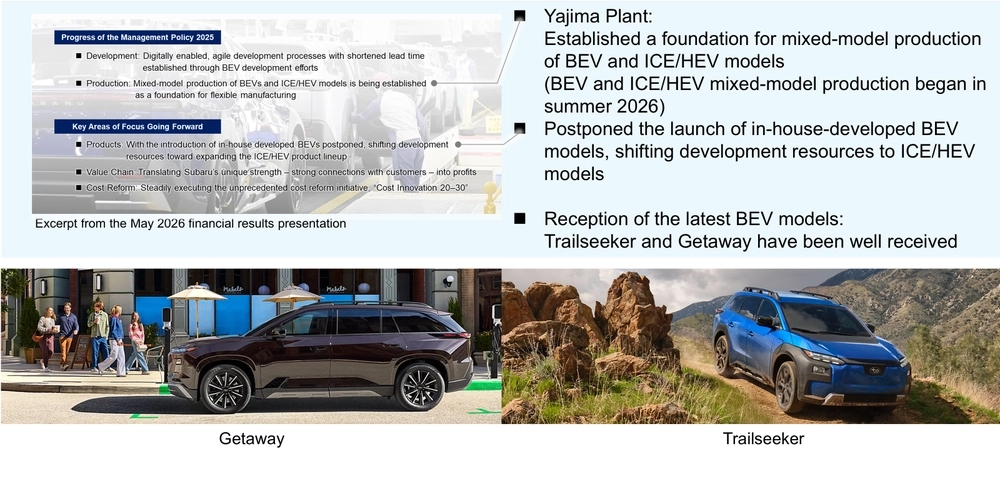
At the financial results briefing in May 2026, Subaru announced a revision to our battery electric vehicle (BEV) strategy and discussed sales trends for BEV models co-developed with Toyota Motor Corporation (Toyota).
At our Gunma Yajima Plant, we established a foundation for mixed-model production of BEV and ICE/HEV models and began BEV production in February 2026*1.
In summer 2026, we also began producing ICE/HEV vehicles on the same line, marking the start of BEV and ICE/HEV mixed-model production.
We decided to postpone the launch of our in-house-developed BEV models and shifted development resources to ICE/HEV models. Leveraging the assets and expertise gained through BEV development, we are stepping up efforts to develop and produce vehicles in a timely manner and to expand our lineup.
The BEV Trailseeker, launched globally, and the three-row SUV Getaway, announced for the U.S. market, have both been well received.
We believe it is a significant achievement that we were able to introduce BEVs to the market while curbing investment through our alliance with Toyota, thereby expanding choices for our customers and accumulating technologies for future use.
*1 Subaru Begins Production of Battery EVs at Gunma Yajima Plant (February 4, 2026)
https://www.subaru.co.jp/news-en/2026_02_04_173507/
Subaru’s Strength
- Flexibility and Expandability through Mixed-Model Production and Bridge Production
We begin by looking at what underpins Subaru’s manufacturing strength.
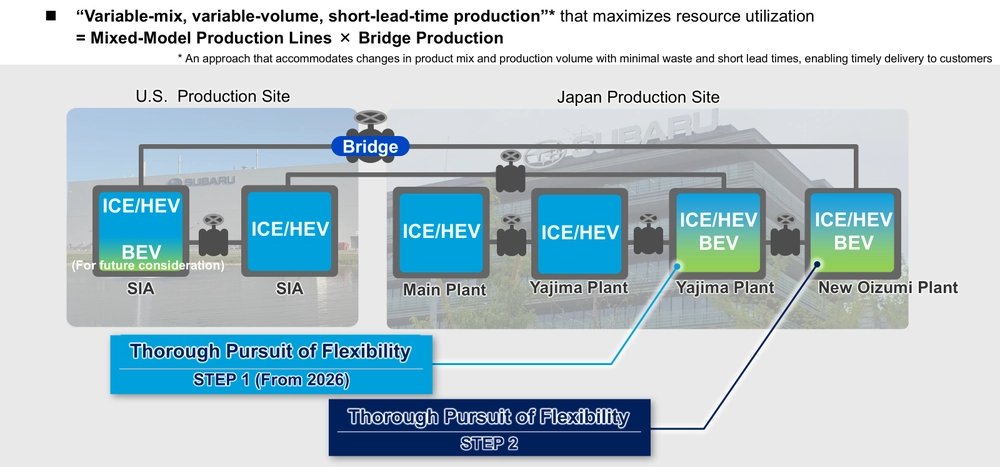
Our strength lies in maximizing the use of our resources through variable-mix, variable-volume, short-lead-time production*2, namely mixed-model production lines and bridge production.
Mixed-model production lines enable multiple vehicle models to be produced on the same line. Bridge production enables the same model to be produced at multiple plants, allowing flexible production allocation among the plants according to demand.
By combining these two approaches, we can respond flexibly to waves of demand and make optimal use of our equipment and workforce.
This forms the core of Subaru’s manufacturing.
*2 Variable-mix, variable-volume, short-lead-time production: An approach that accommodates changes in product mix and production volume with minimal waste and short lead times, enabling timely delivery to customers.
Subaru’s Strength
- Tracing Its History
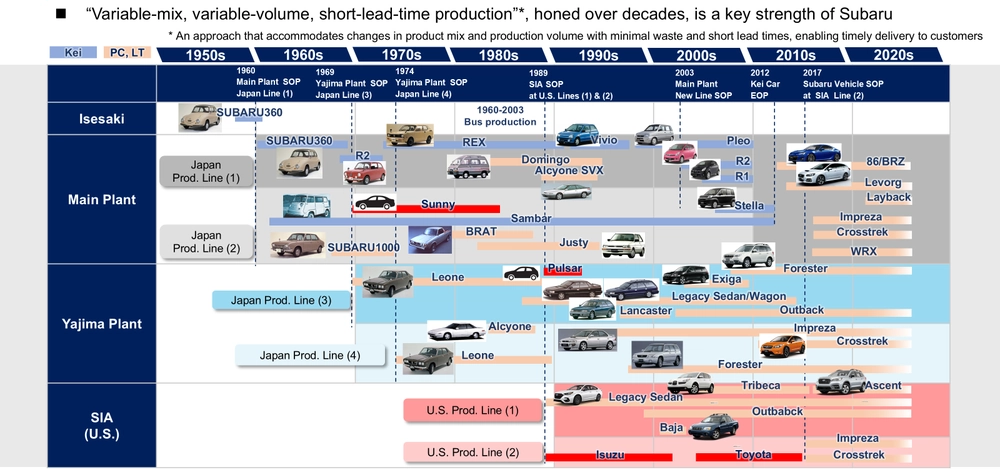
This strength was not built overnight.
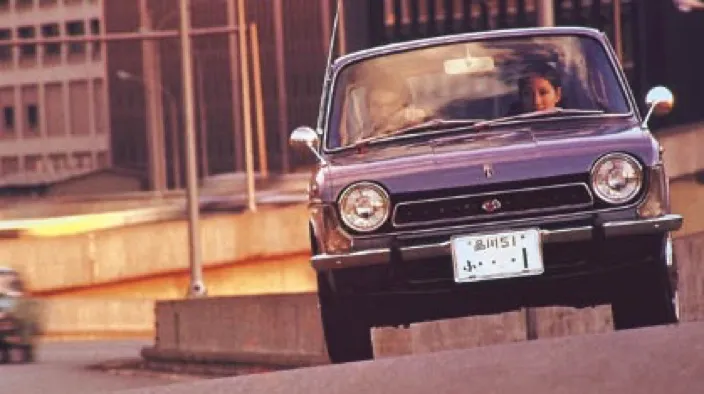
From the production of the Subaru 360 in the 1950s to the present day, we have continued to refine variable-mix, variable-volume, short-lead-time production, making it a strength of Subaru’s manufacturing.
Beyond mixed-model production of our own vehicles, we have also produced vehicles for other automakers, including on the same lines as Subaru models. In Japan, we have experience producing Nissan’s Sunny and Pulsar on the same lines as Subaru models, while in the U.S., we produced vehicles for Isuzu and Toyota within the same plant.
The flexible production capabilities and manufacturing technologies we have cultivated throughout our history represent a strength unique to Subaru.
We believe that further deepening this strength will be the driving force that keeps us competitive in an era of rapid change.
Subaru’s Strength
- Flexibility and Expandability through Mixed-Model Production and Bridge Production
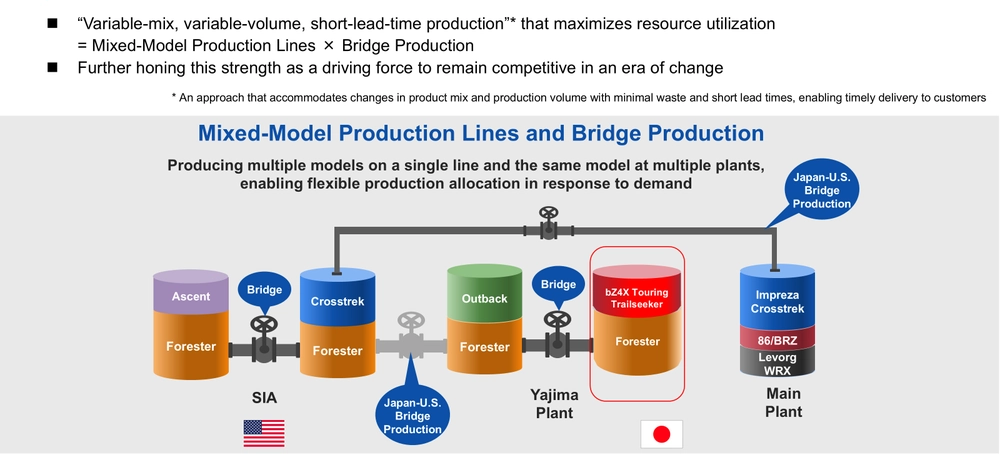
This diagram outlines the structure of Subaru’s mixed-model production and bridge production as of 2026.
The Main Plant and Yajima Plant in Japan, together with Subaru of Indiana Automotive, Inc. (SIA)*3 in the U.S., are each set up to produce multiple models. Together with bridge production spanning Japan and the U.S., we have a structure that allows us to respond flexibly to fluctuations in demand.
We will continue to hone our competitive strengths in mixed-model production, which enables multiple models to be produced on the same line, and bridge production, which enables the same model to be produced at multiple plants.
*3 Subaru of Indiana Automotive, Inc. (SIA): Subaru’s U.S. manufacturing plant
“Ultimate Mixed-Model Production” at the Yajima Plant
- Mixed-Model Production of BEV×ICE/HEV Models and Toyota×Subaru Models
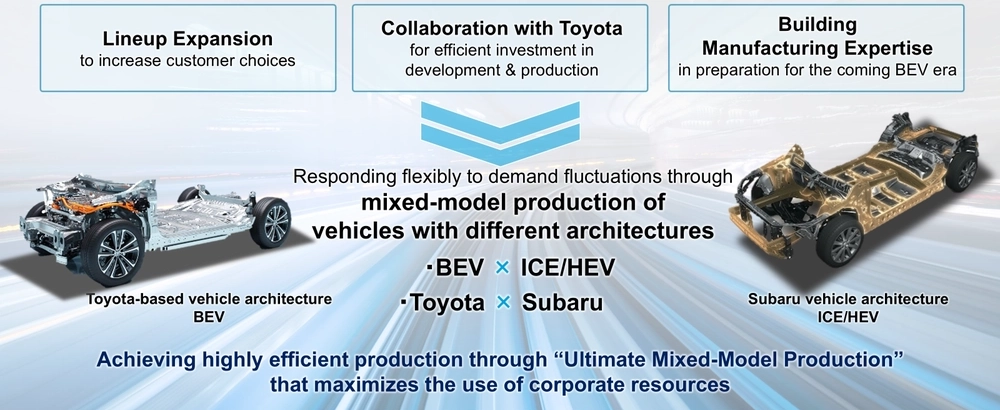
This section outlines the latest mixed-model production initiative at the Yajima Plant.
Through this initiative, we aimed to achieve three types of value simultaneously:
1. Expand choices for our customers by offering both ICE/HEV and BEV models
2. Invest efficiently in development and production through collaboration with Toyota
3. Accumulate manufacturing expertise in preparation for the coming BEV era
Our view that BEVs are the medium- to long-term solution for achieving carbon neutrality remains unchanged. However, in the initial stage of the transition, we need to offer our customers a diverse range of choices, including both ICE/HEV and BEV models.
At the same time, in an era of uncertainty, we need to curb investment through collaboration with other companies while accumulating expertise in production methods for the coming era.
This was the strategy we pursued in light of the scale of our business, and mixed-model production at the Yajima Plant was the specific initiative we took on.
It was an undertaking of exceptional complexity, requiring us to overcome not only differences in vehicle architecture between ICE/HEV and BEV models and between Toyota and Subaru models, but also barriers arising from differences in components and in the “language” of vehicle development.
We will maximize the use of our corporate resources and achieve both highly efficient production processes and high capacity utilization by pursuing “Ultimate Mixed-Model Production,” built on our long-cultivated mixed-model production expertise.
“Ultimate Mixed-Model Production” at the Yajima Plant
- Accommodating BEV×ICE/HEV Models and Toyota×Subaru Models
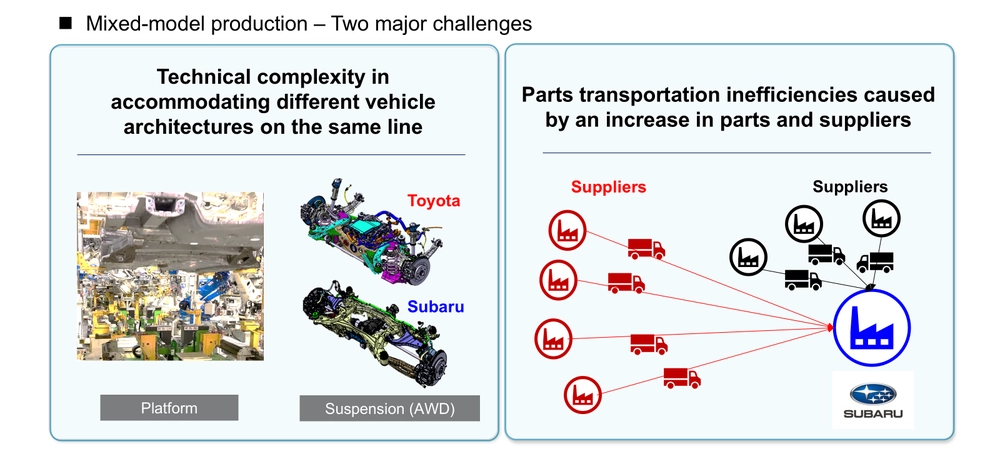
In our efforts to achieve mixed-model production of BEV and ICE/HEV models, as well as Subaru and Toyota vehicles, at the Yajima Plant, we faced two major challenges.
1. The technical complexity of mixed-model production that can accommodate different vehicle architectures on the same line
BEV and ICE/HEV models use different platforms, while the platforms of vehicles co-developed with Toyota also differ structurally from Subaru platforms. As a result, production challenges arise even in a process like suspension assembly.
2. Parts transportation inefficiencies caused by an increased range of parts and an increased number of suppliers
In particular, since many Toyota suppliers are located in the Chukyo region around Nagoya, we faced a host of challenges related to transportation efficiency and costs.
“Ultimate Mixed-Model Production” at the Yajima Plant
- Establishment of Mixed-Model Production Technology to Accommodate Different Vehicle Architectures on the Same Line
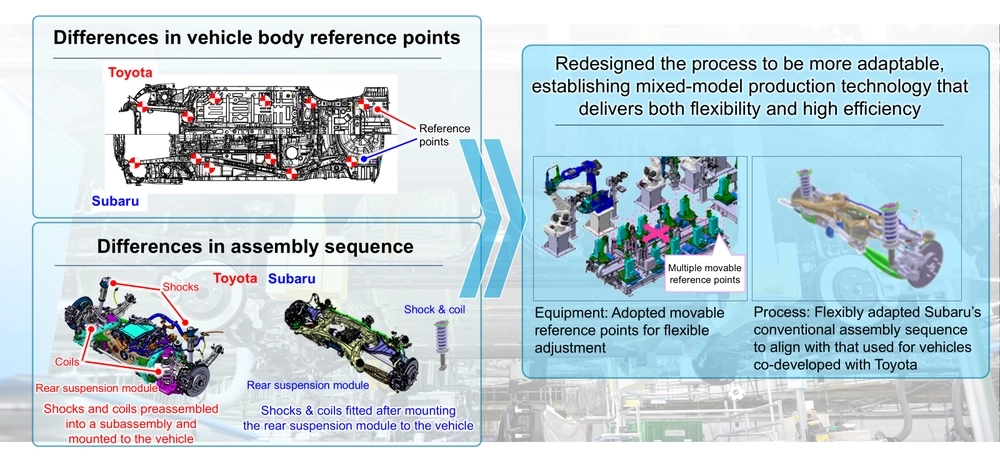
Taking suspension assembly as an example, the reference points used to position the vehicle body differ between Toyota and Subaru, as does the assembly sequence.
We therefore redesigned the process to make it more adaptable and established mixed-model production technology that delivers both flexibility and high efficiency.
On the equipment side, we adopted multiple movable reference points whose positions can be changed flexibly to accommodate differences in vehicle body positioning.
On the process side, we flexibly adapted Subaru’s conventional assembly sequence to align with that used for vehicles co-developed with Toyota. Specifically, we modularized the rear suspension and revised the assembly sequence so that the shocks and coils are fitted after the rear suspension module is mounted to the vehicle.
Vehicles with different architectures now move seamlessly down the same line, and the key to that lies in these movable reference points and flexible process design.
“Ultimate Mixed-Model Production” at the Yajima Plant
- Improving Parts Transportation Efficiency
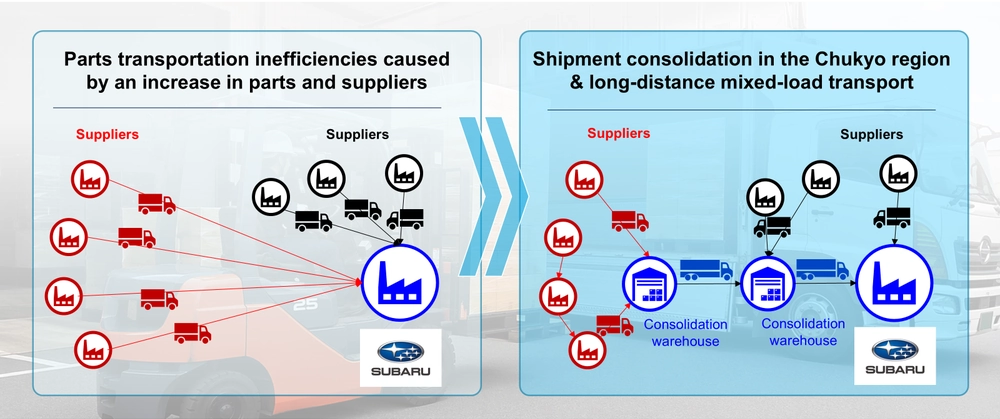
As the range of parts and the number of suppliers increased, the expansion of long-distance transportation, particularly from the Chukyo region, became a major challenge.
To address this, we partnered with Seino Transportation*4, which operates a nationwide logistics network, to establish consolidation warehouses at key locations. Combining shipment consolidation in the Chukyo region with long-distance mixed-load transport has improved transportation efficiency.
As a result of these changes, we have been able to roughly halve the amount of truck transport.
Mixed-model production cannot be achieved through changes to the production line alone. It also requires logistics and supply chain operations that support it.
*4 Subaru and Seino Transportation Launch Collaboration for Automotive Parts Logistics in Japan (February 24, 2026)
https://www.subaru.co.jp/news-en/2026_02_24_110902/
“Ultimate Mixed-Model Production” at the Yajima Plant
- Evolution of the Alliance
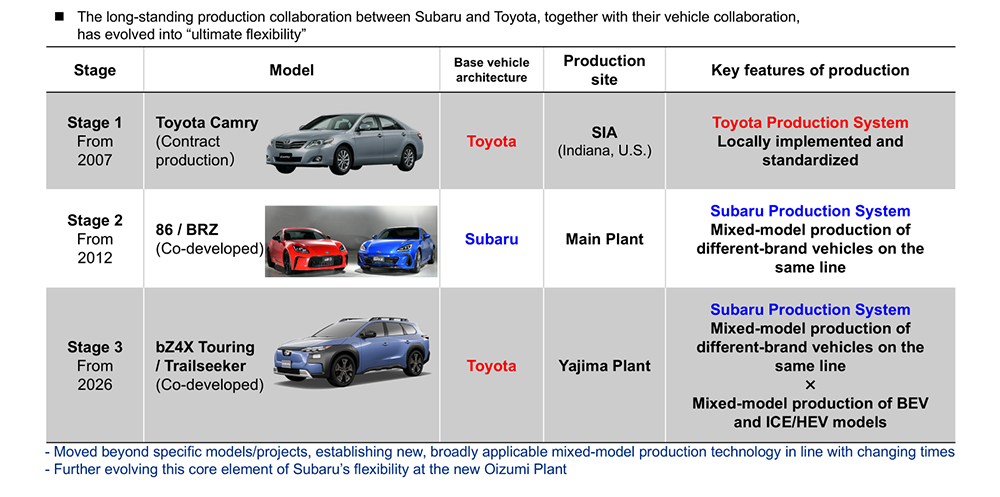
This section retraces the history of our production collaboration with Toyota.
The long-standing production collaboration between Subaru and Toyota, together with our vehicle collaboration, has evolved through three stages into “ultimate flexibility.”
Stage 1
In 2007, we began contract production of the Toyota Camry at SIA in the U.S., where we implemented and standardized the Toyota Production System locally.
Stage 2
In 2012, the co-developed Toyota 86/Subaru BRZ went into production at our Main Plant. By incorporating Toyota’s production equipment standards, we achieved mixed-model production of vehicles from different brands on the same line.
Stage 3
In 2026, our Yajima Plant began producing the co-developed bZ4X Touring/Trailseeker. Under the Subaru Production System, we achieved mixed-model production not only of vehicles from different brands, but also of BEV and ICE/HEV models.
The key point here is that we continued to build on the success of these individual projects, using the technologies and expertise gained to establish new, broadly applicable mixed-model production technology capable of accommodating a wide range of models.
We will further evolve this core element of Subaru’s flexibility at the new Oizumi Plant.
The Ever-Evolving New Oizumi Plant
- Turning Change into Profit
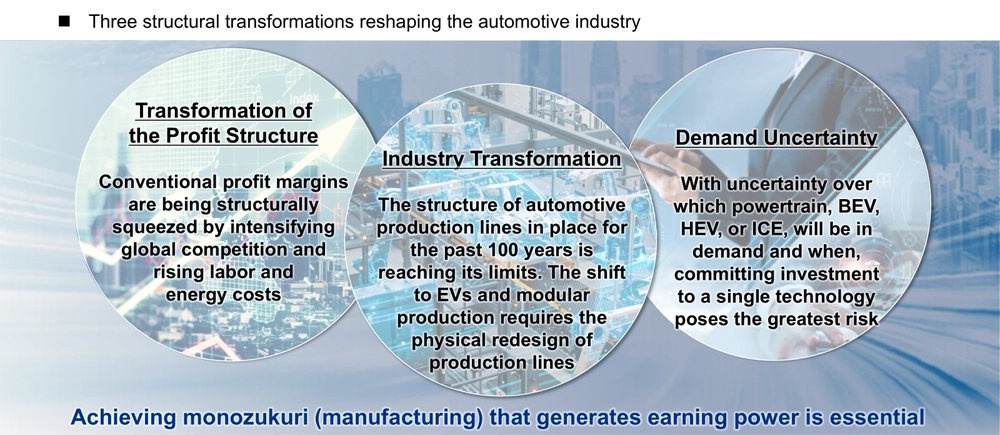
The automotive industry is currently facing three structural transformations.
1. Transformation of the Profit Structure
Conventional profit margins are being structurally squeezed by intensifying global competition and rising labor and energy costs.
2. Demand Uncertainty
With uncertainty over which powertrain, BEV, HEV, or ICE, will be in demand and when, committing investment to a single technology poses the greatest risk.
3. Industry Transformation
Conventional automotive production lines, which have supported vehicle manufacturing for the past 100 years, can no longer accommodate all emerging production needs. The shift to EVs and modular production requires production lines to be physically redesigned.
In other words, the industry as a whole is shifting toward a structure in which simply manufacturing and selling vehicles as before is no longer enough to generate profits.
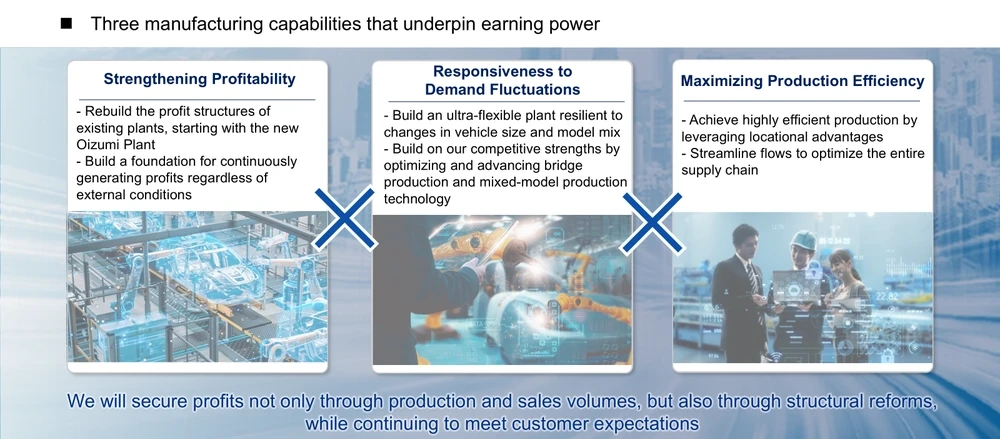
Subaru will respond to these structural transformations with three manufacturing capabilities.
1. Strengthening Profitability
Starting with the new Oizumi Plant, we will rebuild the profit structures of our existing plants and build an operational foundation capable of continuously generating profits regardless of external conditions.
2. Responsiveness to Demand Fluctuations
We will build an ultra-flexible plant resilient to changes in vehicle size and model mix, and build on our competitive strengths by optimizing and advancing bridge production and mixed-model production technology.
3. Maximizing Production Efficiency
We will pursue highly efficient production by leveraging locational advantages and streamline flows to optimize the entire supply chain.
We will secure profits not only through production and sales volumes, but also through structural reforms, while continuing to meet customer expectations.
The Ever-Evolving New Oizumi Plant
- New Plant Concept
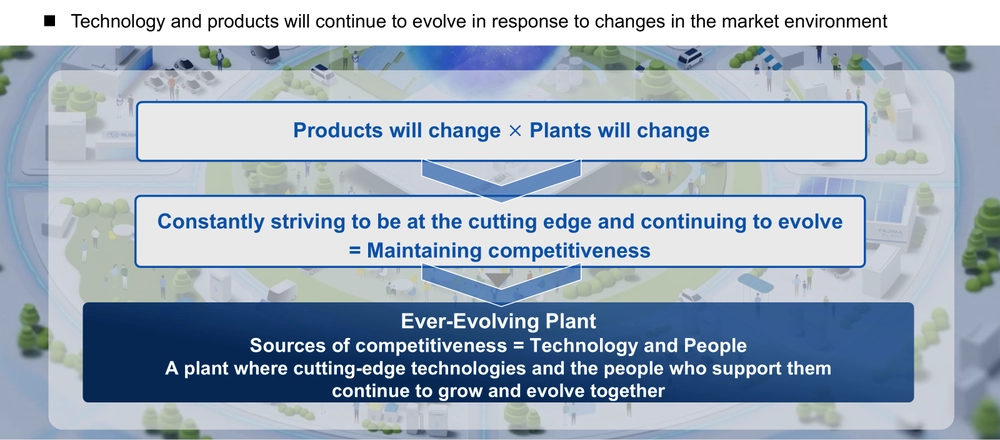
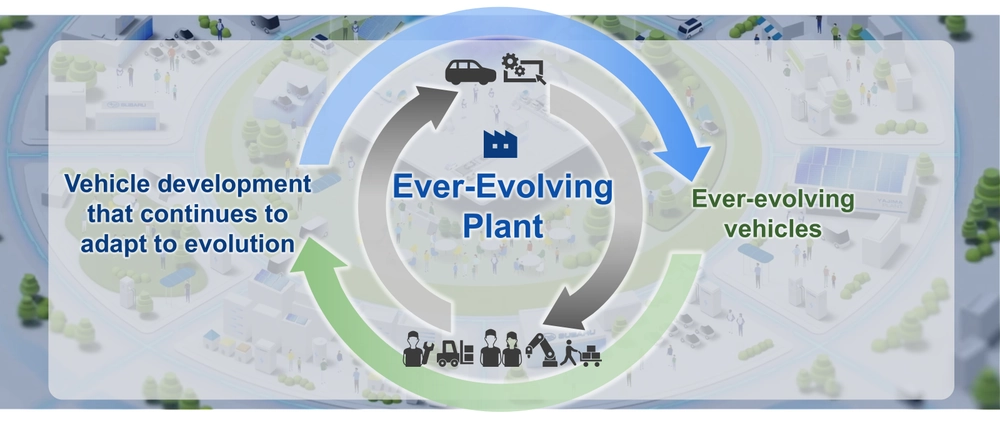
The concept for the new Oizumi Plant is an Ever-Evolving Plant.
As the market environment changes, technologies evolve and products continue to change. In other words, as the vehicles we make change, so do the production environment and the plants where we make them.
By building a new plant from the ground up on a greenfield site, we will be able to incorporate the latest technologies and flexibly develop and produce vehicles in line with market needs. By continually striving to stay at the cutting edge, we aim to maintain our competitiveness.
The concept of a Software-Defined Factory (SDF)*5 will also form part of the foundation for this Ever-Evolving Plant.
Just as we are entering the era of the Software-Defined Vehicle (SDV)*6, in which vehicles continue to evolve through software, plants are evolving as well, with their functions defined and continuously updated through software and data.
New model launches and process reconfigurations will be carried out as flexibly as possible through software updates rather than large-scale equipment modifications. By minimizing physical modifications, we will continuously update the plant’s functions.
Through this approach, we intend to take the speed and cost of responding to change to an entirely new level and provide a solid foundation for the new Oizumi Plant’s goal of turning change into profit.
A plant that continues to turn change into profit rather than allowing change to result in higher costs and disruption.
A plant where technology and people, the sources of our competitiveness, serve as twin drivers of continued growth and evolution.
That is our vision for the new Oizumi Plant.
*5 Software-Defined Factory (SDF): Manufacturing systems that leverage software and data to optimize entire plants and respond flexibly to change
*6 Software-Defined Vehicle (SDV): An approach that involves continuously enhancing vehicle performance and value through software updates and additional features
The Ever-Evolving New Oizumi Plant
- Building the Foundation for Flexible Production
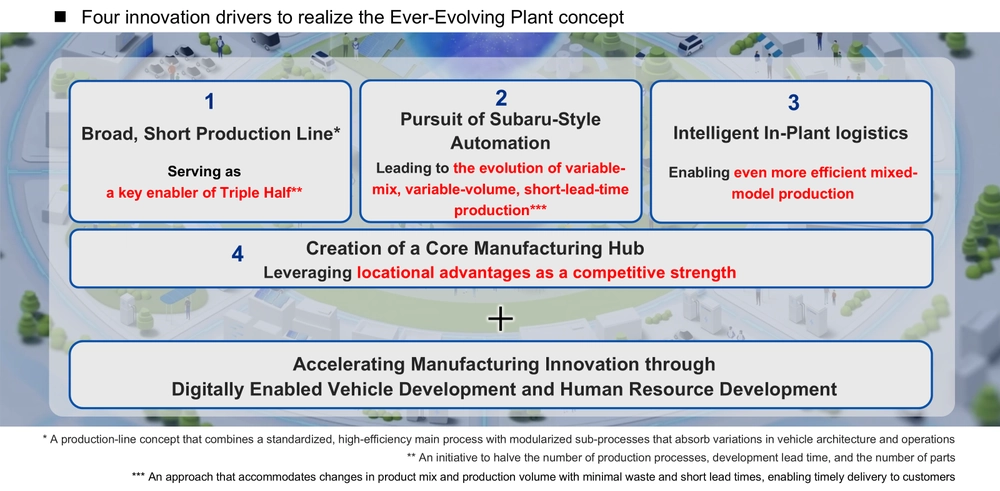
We are aiming to realize the Ever-Evolving Plant concept through four innovation drivers.
1. Broad, Short Production Line*7, which will serve as a key enabler of Triple Half*8.
2. Pursuit of Subaru-Style Automation, which will lead to the evolution of variable-mix, variable-volume, short-lead-time production.
3. Intelligent In-Plant Logistics, which will enable even more efficient mixed-model production.
4. Creation of a Core Manufacturing Hub that leverages locational advantages.
In addition to these four innovation drivers, we will accelerate manufacturing innovation through digitally enabled vehicle development and human resource development.
*7 Broad, Short Production Line: A production-line concept that combines a standardized, high-efficiency main process with modularized sub-processes that absorb variations in vehicle architecture and operations.
*8 Triple Half: An initiative to halve the number of production processes, development lead time, and the number of parts.
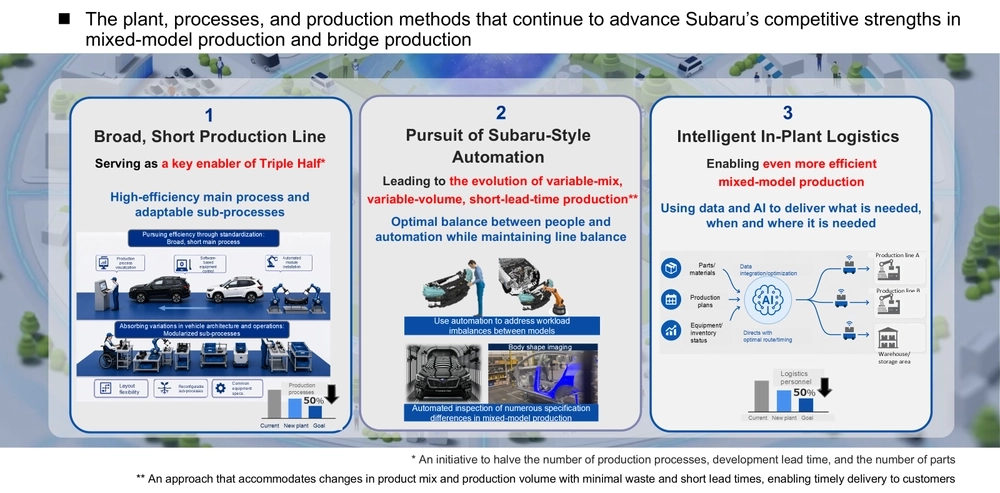
Among the four innovation drivers, this section outlines the production line concept in more detail.
1. Broad, Short Production Line
The key is to separate the highly efficient main process from the sub-processes that absorb change.
We will combine a broad, short main process designed to achieve high efficiency through standardization with modularized sub-processes that absorb variations in vehicle architecture and operations. This will enable us to produce a wide variety of models without disrupting line balance.
2. Pursuit of Subaru-Style Automation
We will also pursue the optimal balance between people and automation. Building on our history and strengths in flexibility, we will take advantage of the opportunity to build the plant from the ground up to realize Subaru-style automation that is resilient to change, rather than seeking to automate everything.
To take this automation to the next level, we are also preparing with a view to introducing physical AI.
Physical AI can be described as “AI with a body.” It recognizes its real-world surroundings, makes decisions, and takes action on its own. Rather than requiring each individual operation to be programmed in detail in advance, physical AI understands the situation and flexibly adapts on the spot to changes in vehicle models and operations. This represents the next generation of automation, working in coordination with people.
Because the new Oizumi Plant is being built from the ground up on a greenfield site, these cutting-edge technologies can be incorporated from the initial concept and design stages. By incorporating technological advances, the plant itself will continue to learn and become smarter. This is another important aspect of the Ever-Evolving Plant.
3. Intelligent In-Plant Logistics
We will also use data and AI to make in-plant logistics more intelligent, addressing a trade-off associated with variable-mix, variable-volume, short-lead-time production. By delivering what is needed, when and where it is needed, we aim to improve logistics efficiency by 50% compared with the current level as of 2026.
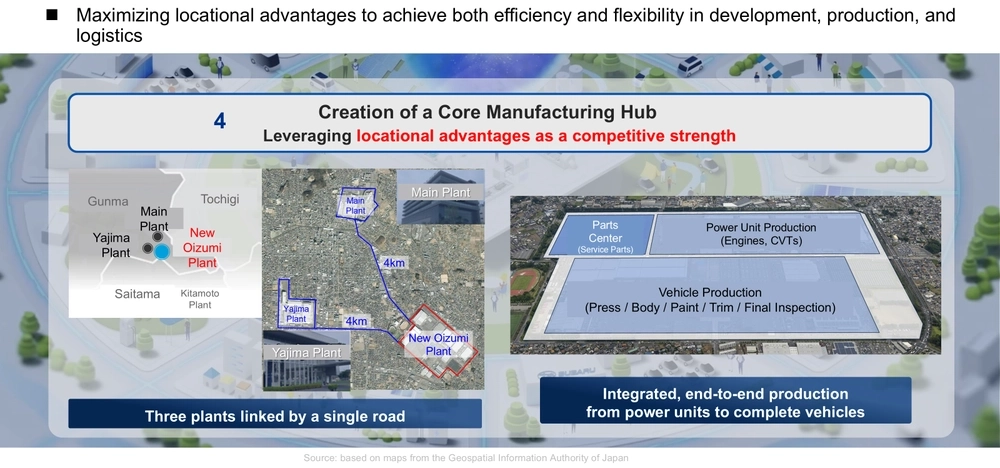
This section outlines locational advantages as the fourth innovation driver.
4. Creation of a Core Manufacturing Hub
Subaru’s plants and suppliers are concentrated in Gunma Prefecture. By maximizing this advantage, we aim to achieve both efficiency and flexibility in development, production, and logistics.
Our three plants in Gunma, the Main Plant, the Yajima Plant, and the new Oizumi Plant, are located only about four kilometers from one another and are linked by what can be described as a single road. This close proximity will help reduce both time and costs.
At the new Oizumi Plant, we will take advantage of the opportunity to build the plant from the ground up and establish a system for producing power units and complete vehicles in an integrated, end-to-end manner.
The Ever-Evolving New Oizumi Plant
- To Continue to Be Chosen by Our Customers
Subaru has a history of flexible production made possible by the scale of our business, and we have long cultivated this approach through bridge production at the Main Plant, Yajima Plant, and the U.S. plant, as well as mixed-model production that has included vehicles for other automakers.
At the Yajima Plant, we overcame the major challenges of producing Toyota and Subaru vehicles, as well as BEV and ICE/HEV models, on the same line, achieving Ultimate Mixed-Model Production and further advancing our production flexibility.
Amid major structural transformations, we will build on the knowledge, methods, and expertise accumulated to date at the new Oizumi Plant. Through digitally enabled vehicle development and human resources suited to the changing times, we aim to create an Ever-Evolving Plant that consistently generates profits.
Vehicle development that continues to adapt to evolution, an Ever-Evolving Plant, and ever-evolving vehicles.
To continue to be chosen by our customers, we will keep pursuing flexibility and evolving our manufacturing.