
Realizing a Circular Economy
Our Approach
SUBARU considers realizing a circular economy to be one of its key priorities.
Effective use of finite resources is essential to sustaining the SUBARU Group’s business activities. To reduce dependence on newly extracted resources, we have established interim targets focused on promoting the use of recycled materials and reducing waste.
Management System
Through the Environment Committee, SUBARU discusses medium- and long-term targets for realizing a recycling-oriented society and evaluates the progress of its initiatives. For details on the SUBARU Group’s management system for circular economy-related matters, please see the following link.
Targets and Results
As an interim target to be achieved by FYE March 2031, we have set the goal of proceeding with research and development with the aim of using recycled materials for at least 25% of the plastics used in new models by 2030. To achieve this target, we are working to establish quality standards for recycled plastics and a raw material recovery scheme. For waste generated by SUBARU, we have set targets to reduce the total amount of waste by 1% annually versus business-as-usual (BAU) emissions and achieve zero emissions at production plants in Japan and overseas, with the aim of reducing both total waste and final disposal volumes.
Key Achievements
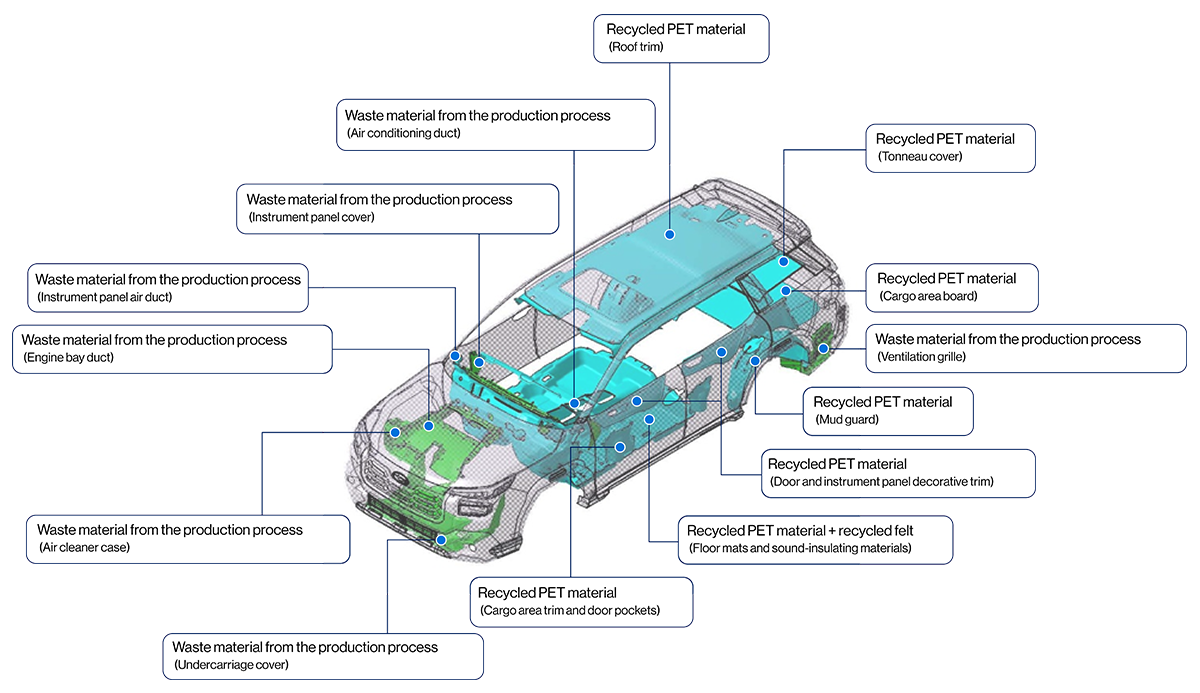
To contribute to realizing a resource-recycling society and a decarbonized society, SUBARU proactively uses recycled materials, including recycled plastics used in automobiles. The new Outback launched in the U.S. in 2025 uses recycled materials in significantly more areas than previous models.
As part of its efforts to reduce the environmental impact of its business sites, SUBARU is working to reduce total waste and maintain zero emissions. In FYE March 2026, SUBARU’s total waste amounted to 102,000 tons. Although this did not meet the target value (96,000 tons), SUBARU continued to achieve zero emissions.
Example: New Outback
Initiatives
SUBARU promotes vehicle manufacturing with recycling in mind to make effective use of limited resources, working on resource efficiency throughout the entire lifecycle of automobiles, from raw material procurement and manufacturing to disposal.
In addition to continuing to promote the use of recycled materials and push for zero landfill at production sites both in Japan and overseas, we are also advancing research on the use of diverse sustainable materials and developing upcycled products using scrap materials.
Product Initiatives
To realize a circular economy, SUBARU promotes vehicle manufacturing that considers the effective use of resources from the product design stage. Through a multifaceted approach that includes thorough design for recycling, the use of recycled and biomass materials, and the creation of new value through upcycling, we promote the effective use of resources.
Design for Recycling
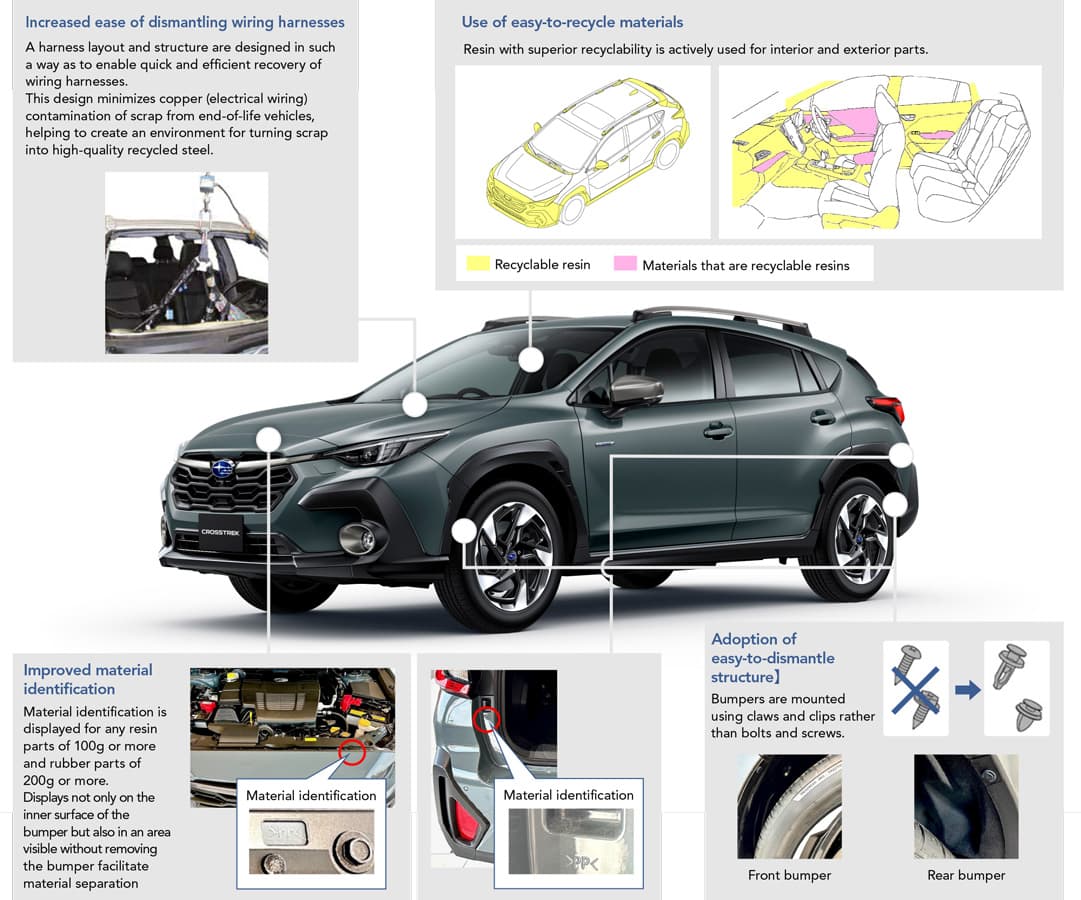
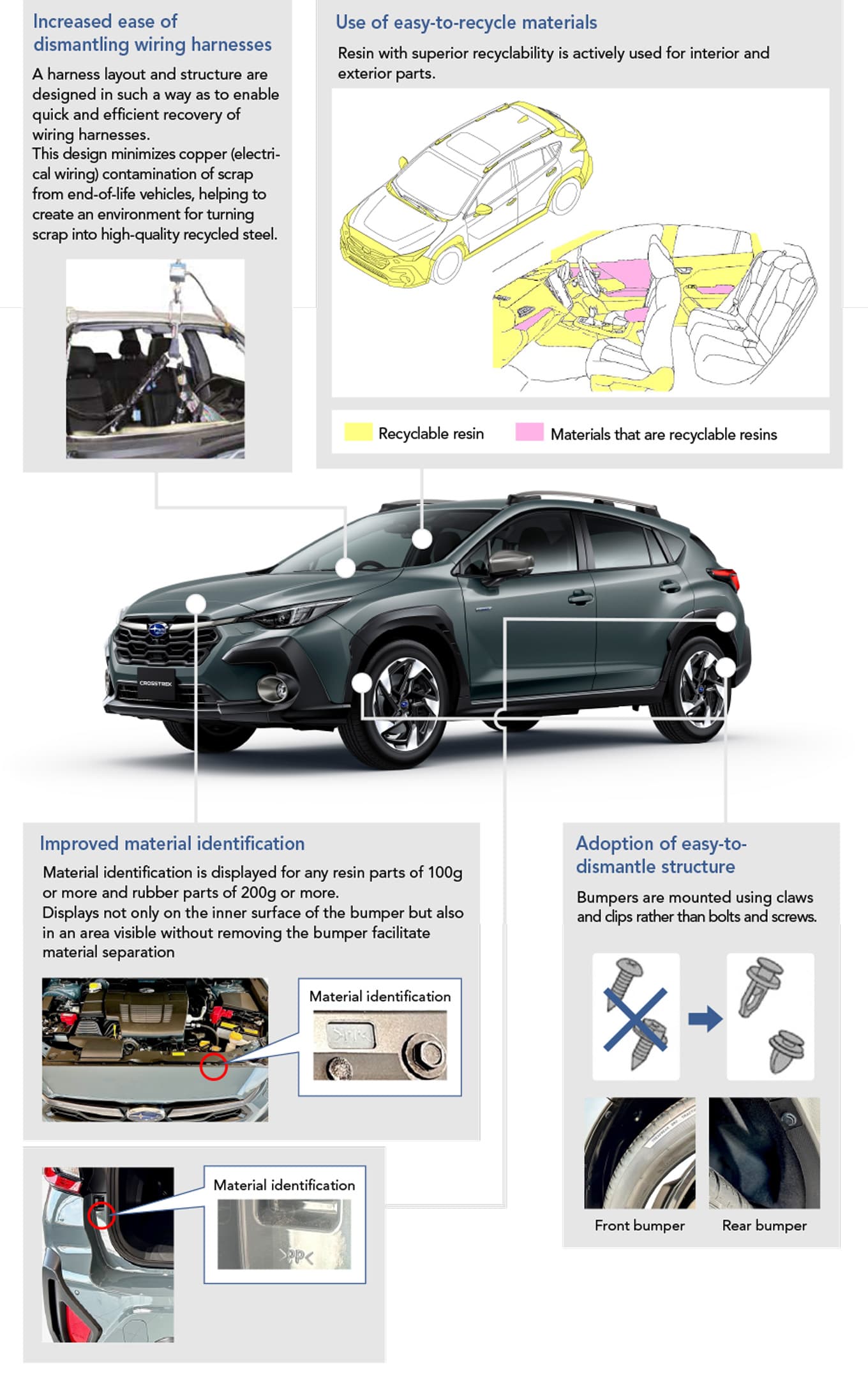
SUBARU incorporates recyclability into its automobile design process to make effective use of limited resources. In addition to providing a structure for easy disassembly and separation using an easy-to-disassemble wiring harness layout and visibility-oriented material identification, we use easy-to-recycle materials for parts in the interest of recycling.
Use of Recycled Materials
As described above, SUBARU is actively promoting the introduction of recycled materials, particularly recycled plastics.
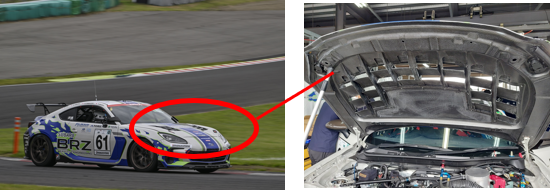
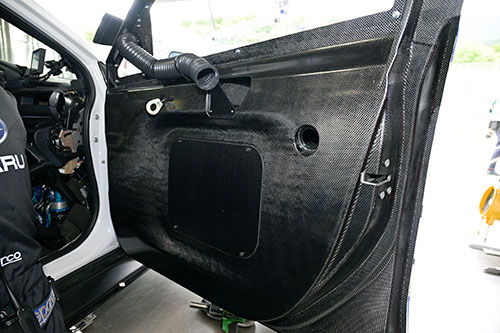
In addition to their use in mass-produced vehicles, carbon fiber rear wings, roofs, doors, and other components made with recycled carbon fiber (recycled carbon) derived from carbon-fiber composite waste generated during aircraft parts manufacturing were used in the HIGH PERFORMANCE X FUTURE CONCEPT, SUBARU’s entry in the Super Taikyu Series of races. The recycled carbon is also used for the front hood of the MAZDA SPIRIT RACING MAZDA3 Bio concept, Mazda’s entry in the Super Taikyu Series.
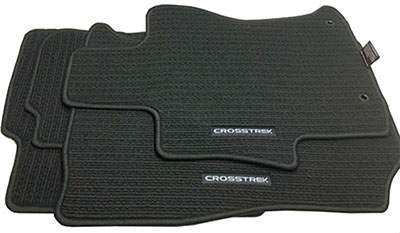
Subaru of America, Inc. (SOA) has also developed environmentally friendly accessories, specifically floor mats made from materials recycled from marine debris. Both the surface and backing consist of 100% recycled materials. Through the sale of these floor mats, we were able to use approximately 490 tons of recycled materials in 2025.
R&D for biomass materials
In addition to recycled materials, SUBARU is promoting research and development of plant-derived materials.
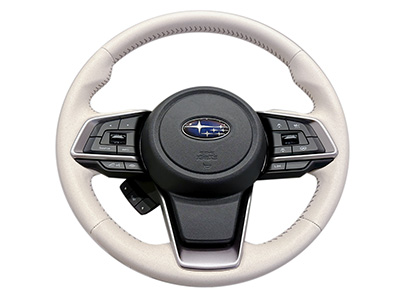
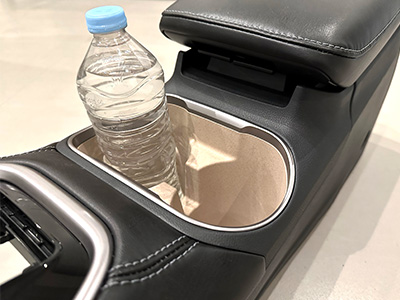
Residues that must be incinerated during the processing of food and other products have recently become a social issue. For example, mixing post-juicing fruit residues and thinned wood into resins allows us to cut down on petroleum-based resin use. By effectively utilizing this waste as raw materials for automobile parts, we are not only recycling resources but also conducting research so that customers can appreciate the significance of using these materials and their natural texture.
(Prototype)
(Prototype)
Upcycling Initiatives
Upcycling is the practice of adding new value to items that would otherwise have been discarded.
SUBARU focuses on offcuts generated during product manufacturing and actively promotes collaboration with other companies in addition to its own activities, working to create new value beyond the boundaries of the automotive industry.
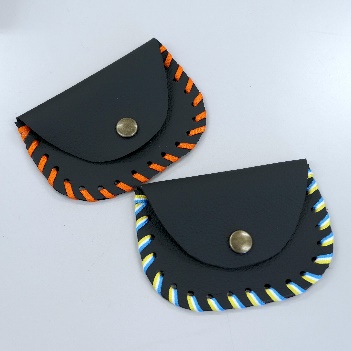
For example, in FYE March 2026, SUBARU collaborated with certain dealerships and local universities to hold several workshops on making coin cases from genuine leather seat scrap material. SUBARU continues to expand these upcycling activities to promote the effective use of resources and further raise environmental awareness.
Site Initiatives
By thoroughly recovering, reusing, and recycling waste generated through production and business activities, SUBARU has maintained the zero emissions*1 target set in its Environment Action Plan since FYE March 2015. SUBARU has also set a waste reduction target beginning in FYE March 2026 and is working to curb waste generation by reusing offcuts from production processes and through other measures.
- *1
- Zero emissions is defined as a final disposal amount (total amount of direct landfill waste + landfill waste after intermediate processing) less than 0.5% of the total amount of waste (total amount of valuable resources + industrial waste + specially controlled industrial waste + general business-related waste).
Initiatives in Production Processes
SUBARU promotes resource circulation by recovering, reusing, and recycling offcuts and by-products generated through production activities. In addition to reuse within production processes, SUBARU makes more effective use of limited resources by developing materials made from waste.
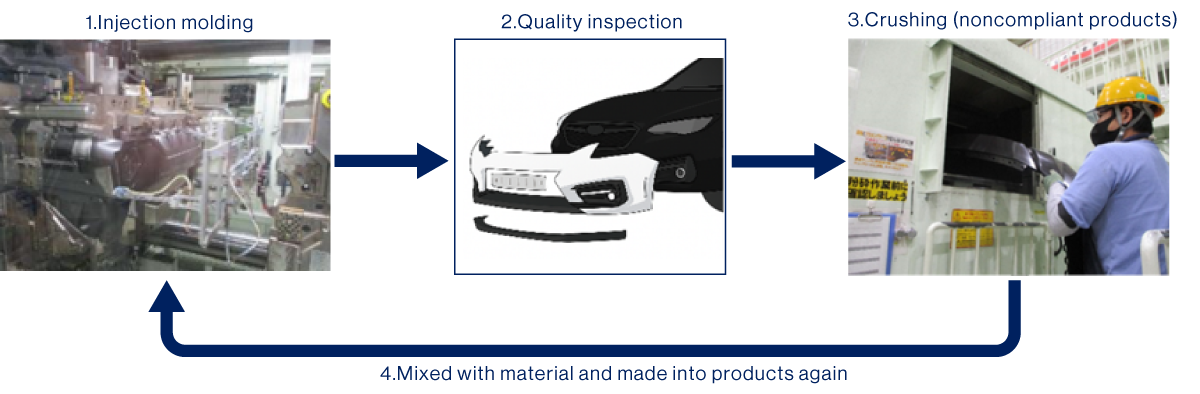
For example, SUBARU remelts machining chips generated during the production of engine cylinder blocks and reuses them as raw material for die casting. In the bumper manufacturing process, certain unpainted bumpers that fail quality inspection are crushed in-house and reused as material for bumpers.
Reuse in the Bumper Manufacturing Process
In addition, Subaru of Indiana Automotive, Inc. (SIA), an overseas production base, continues to undergo audits and obtain certification from the third-party certification body GreenCircle Certified for its Zero Waste to Landfill initiative as it works to achieve resource recycling.
Reducing Waste in Offices
By also working to reduce general waste in offices, the SUBARU Group aims to raise awareness of resource recycling among all employees.
Paper, including office paper, is a major source of office waste. At SUBARU, we are taking actions to go paperless by fully digitizing payment guides for our business partners to be available online and achieving paperless processing of internal accounting documents related to maintenance parts and vehicle accessories. SOA has also introduced an electronic signature service that enables all procedures, such as contracts and approvals, to be completed online, reducing paper use by approximately 316,000 sheets in FYE March 2026.
SUBARU is also working to reduce and effectively utilize food scraps and waste cooking oil generated by employee cafeterias. The Ebisu Subaru Building, SOA, and other sites are promoting the reuse of food waste as animal feed and compost. In addition, each site is working to recycle waste cooking oil. Subaru Logistics Co., Ltd. participates in the Fry To Fly Project, which produces sustainable aviation fuel (SAF) from waste cooking oil, and contributes to SAF production by providing waste cooking oil generated by the employee cafeteria and other facilities at its headquarters.
SOA is also working to achieve zero landfill waste at Subaru Park, a soccer stadium, and recycled a cumulative total of more than approximately 900 tons of waste over the four years through 2025.
Effective Use of Waste through Employee Participation
SUBARU is promoting initiatives in which employees take an active role in reusing and recycling resources generated through business activities and daily operations.
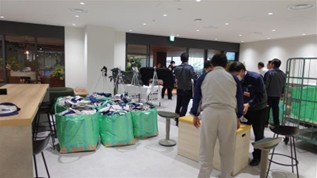
As SUBARU updates its uniforms, it has begun collecting and recycling the retired uniforms. The initiative, launched at the Main Plant in Ota City in March 2026, was expanded beyond the Gunma region to all of SUBARU. By May 2026, 3.5 tons of uniforms had been collected. The collected uniforms are shredded, fiberized, and converted into felt, which is then made into automotive sound-insulating material. In the future, some of the uniforms collected by SUBARU will be used in vehicles produced by SUBARU.
SIA conducts an annual initiative to collect and recycle waste generated in employees’ homes. SOA also collects e-waste (waste from electric and electronic devices) from employees’ homes through events such as Earth Day and processes it for recycling.
Resource Recycling Initiatives in Sales and After-Sales
The SUBARU Group is working to realize a recycling-oriented society by reducing waste generated through sales activities and effectively utilizing resources.
Reducing Waste at Sales Locations
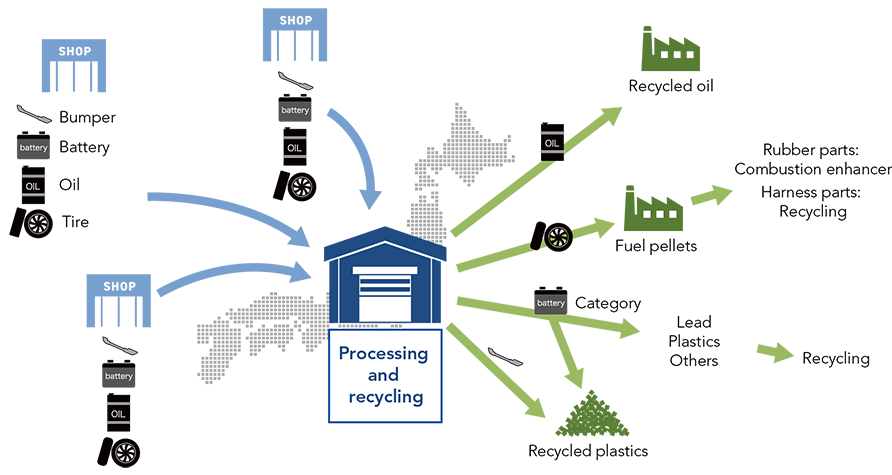
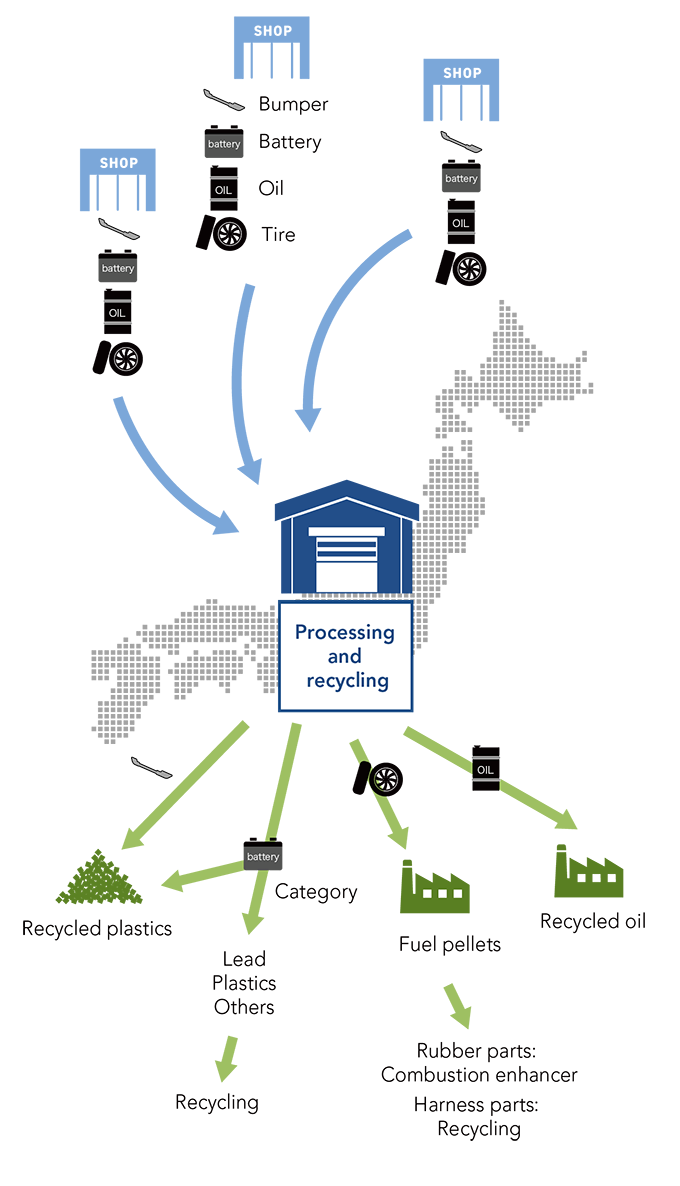
SUBARU dealerships are committed to the proper management of waste generated from their business activities and to promoting recycling in Japan through zero-emissions activities. In FYE March 2026, the following resources were collected through this initiative:
・Used bumpers: 26,006
・Lead batteries: 157,752 (lead recovered: 2,170 t)
・Waste oil: 4,961 kL
・Tires: 214,356
After collection, used bumpers are crushed and pelletized, then reused in products such as shipping pallets.
Waste oil generated at dealerships is converted into recycled fuel oil under SUBARU’s unique zero waste emissions scheme and used as an alternative to conventional fuel oil. Some of this recycled fuel oil is used to heat agricultural greenhouses. For example, horticultural farmers in Yamagata Prefecture use it to help grow crops. Zero-emission activities at dealerships, which are closest to customers, are important initiatives for reducing environmental impact and using resources effectively. SUBARU will continue to promote initiatives toward realizing a recycling-oriented society and aim to be a brand that customers continue to choose for the “Enjoyment and Peace of Mind” it provides.
As for dealerships outside Japan, SOA has launched the Eco-Friendly Program to reduce environmental impact, including waste. The program certifies dealerships that meet its recycling standards. As of 2025, 262 dealerships, or approximately 41% of all U.S. dealerships, were participating. For materials generated from sales activities, we are also working to reduce waste and use recycled materials. Through initiatives such as EcoVadis, an international platform that assesses the environmental performance of business partners, we are promoting waste reduction throughout the supply chain.
Zero emission initiatives led by dealerships, which work most closely with customers, are activities that will contribute more directly to environmental conservation in local communities. The initiatives are expected to help promote proper processing, recycling, and the effective use of resources, while also contributing to SUBARU's goal of being a brand that customers continue to choose for the Enjoyment and Peace of Mind it provides.
Proper Collection and Resource Recovery of End-of-Life Vehicles
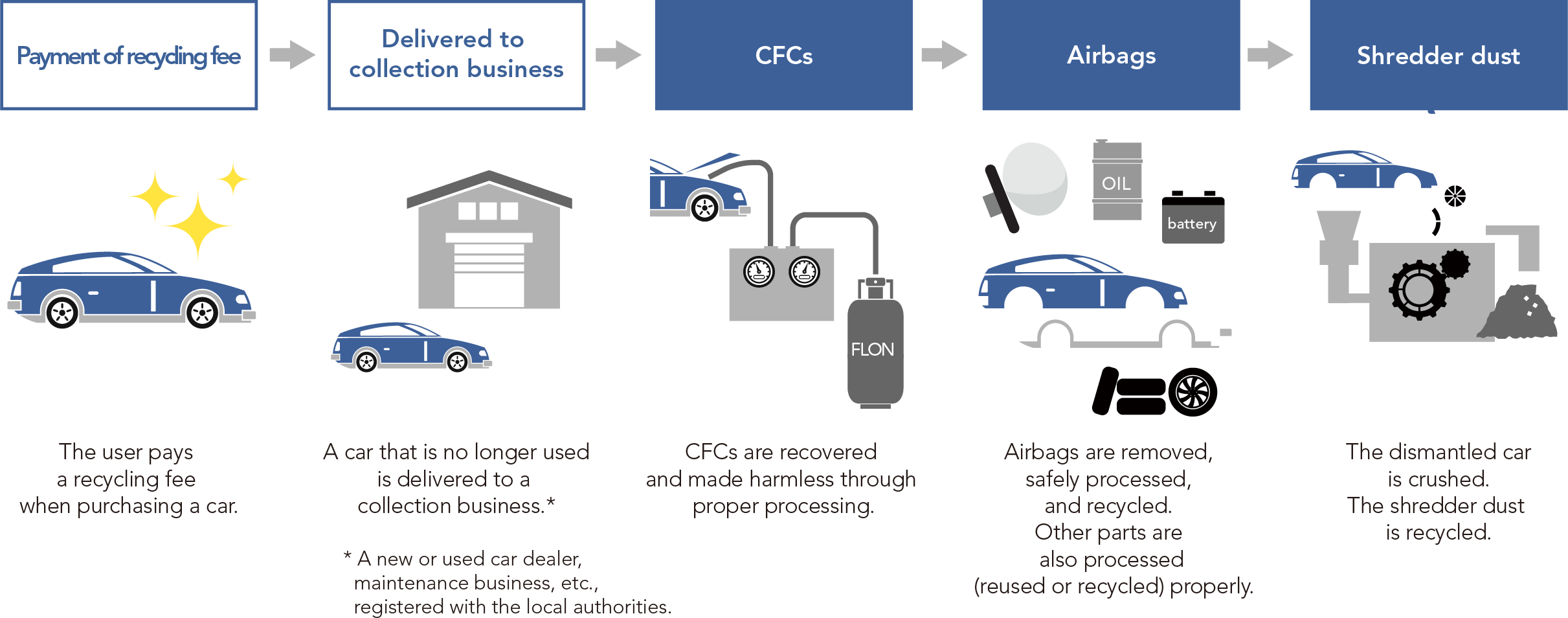
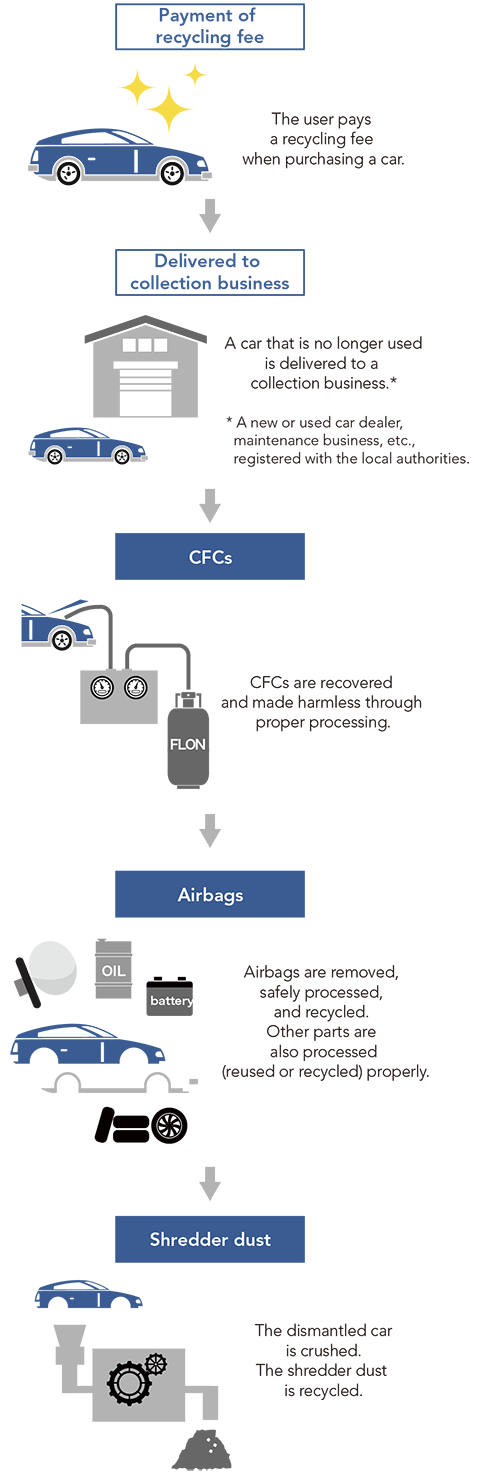
Under the Act on Recycling, etc. of End-of-Life Vehicles of Japan, car manufacturers are required to fully recover and properly recycle airbags, chlorofluorocarbons (CFCs), and automotive shredder residue (ASR) from their end-of-life vehicles. SUBARU promotes the proper processing of these materials and works to improve their recycling rates.
Airbags and CFCs are processed through Japan Auto Recycling Partnership Ltd., established jointly with Japanese automakers and importers. In FYE March 2026, the airbag recycling rate was 96.6%, exceeding the legal target of 85%, and all CFCs recovered were processed properly.
We also promote the smooth, proper, and efficient recycling of ASR through the Automobile Shredder Residue Recycling Promotion Team (ART).*1 In FYE March 2026, the ASR recycling rate was 96.3%, achieving the legal target of 70% for FYE March 2016 and thereafter.
Detailed information on the level of progress with these recycling initiatives and SUBARU’s other activities based on the Act on Recycling, etc. of End-of-Life Vehicles is disclosed separately on the web page indicated below.
- *1
- A team to promote the recycling of ASR, organized by 12 domestic automobile manufacturers and importers in 2003. The team plans the smooth, proper, and efficient recycling of ASR, a waste product that is classified as one of the Parts Specified for Recycling as defined by the Act on Recycling, etc. of End-of-Life Vehicles and required to be recycled under the law
- About the Act on Recycling, etc. of End-of-Life Vehicles (Japanese version only)
- Automobile shredder residue Recycling Promotion Team (ART) (Japanese version only)
Automobile Recycling Process
In Europe as well, the End-of-Life Vehicles (ELV) Directive requires the reuse and recycling of automobiles and the reduction of environmental impact. We are addressing these requirements by considering recyclability and ease of dismantling from the vehicle design stage and working to promote the reuse of parts and recovery of resources from end-of-life vehicles.
Going forward, we will continue to contribute to reducing the use of natural resources and environmental impacts by promoting resource recycling.
Battery Recycling
Lithium-ion drive batteries that have been distributed in the Japanese market are being collected appropriately through a collection scheme by Japan Automobile Manufacturers Association, Inc. (JAMA). In addition, for nickel-metal hydride batteries installed in previously sold vehicles, battery manufacturers themselves have obtained certification under the Ministry of the Environment’s Cross-Jurisdictional Waste Treatment Disposal Certification System and collect and process them nationwide.
In North America, SOA uses a third-party service provider’s management process to collect, transport, and recycle end-of-life drive batteries while ensuring safety and traceability.
In Europe, the EU Batteries Regulation (EU 2023/1542) is strengthening requirements throughout the battery lifecycle. In addition to collection and recycling, traceability and the use of recycled materials are also becoming mandatory. In light of these regulatory trends, SUBARU is working to establish systems for collecting and recycling end-of-life batteries, ensure traceability throughout the supply chain, including compliance with battery passport requirements, and explore the use of recycled materials.
Use of Rebuilt Items
Toward realizing a recycling-oriented society, SOA is promoting the use of rebuilt items*2 to replace engines, transmissions, and other large parts to reduce environmental impact and ease the cost burden on customers. These rebuilt items*2 are reused after all replacement parts, such as seals and gaskets, have been removed and replaced with parts that meet the same high quality standards as genuine parts installed at the factory.
- *2
- Repair parts such as engines, etc., for which consumable parts are replaced and usable parts are reused in accordance with inspection standards.
Logistics Initiatives
To realize a circular economy, the SUBARU Group is also working to reduce resource use and promote the circular use of resources in logistics.
Reduction of Packaging and Packing Materials and Environmental Measures
The Company’s Parts Distribution Center is promoting the use of environmentally friendly packaging materials, including replacing cardboard and plastic packaging materials with paper equivalents and adopting packaging materials with 10% biomass plastic material content. In addition, we are reviewing packaging material specifications (e.g., eliminating packaging, reducing its size, and adjusting its thickness) to reduce material use and waste.
We are also switching from wood to cardboard as a packaging material on shipment for large parts such as bumpers, engines, and transmissions. We have also begun addressing the EU’s new Packaging and Packaging Waste Regulation (PPWR)*1 and are working to reduce packaging waste and further promote recycling.
SOA uses high-strength packaging for unpainted bumpers exported from Japan, eliminating the need to repackage them for transportation within the U.S. and streamlining logistics operations.
- *1
- PPWR is a regulatory framework in the EU aimed at reducing packaging waste, strengthening recycling obligations, and curbing excessive packaging, among other objectives.
Reuse of Packaging Materials
Subaru Logistics Co., Ltd., which handles packaging and transport for complete knockdown (CKD) parts of SUBARU automobiles, has been actively working on reducing its environmental impact, focusing on the reuse of packaging materials. The amount of reusable packaging materials handled in FYE March 2026 was 1,169 tons, up 11% year on year. This was due to a 5% year-on-year increase in the number of units shipped, as well as the adoption of reusable materials for packaging large parts following the start of U.S. production of the Forester. Going forward, we will continue to promote the reuse of materials to reduce environmental impact.
(FYE March)
| 2019 | 2020 | 2021 | 2022 | 2023 | 2024 | 2025 | 2026 | |
|---|---|---|---|---|---|---|---|---|
| Amount reused (t) | 776 | 1,020 | 661 | 786 | 852 | 1,023 | 1,055 | 1,169 |
| Intensity (kg/vehicle) | 2.8 | 2.4 | 2.7 | 2.8 | 2.8 | 3.1 | 2.1 | 3.3 |