
Environmental Management
Our Approach
In its Environmental Policies, SUBARU defines “the earth, the sky and nature” as its fields of business and considers protecting the environment the most important theme for ensuring a sustainable future for both society and SUBARU. Furthermore, the Group has defined the Environment as one of our Six Priority Areas for Sustainability, and considers activities for the environment as key to the continuation of our business.
The SUBARU Group’s vision for the Environment is to “Cherish and protect the environment—the earth, the sky and nature—through Group-wide activities.” It has identified three priority themes: mitigating climate change, realizing a circular economy, and coexistence with nature. By advancing initiatives based on these priority themes, we aim to reduce our environmental impact on the natural world to virtually zero and go even further to make a positive impact.
Sustainability Policies and Guidelines:
SUBARU Environmental Policies
Management System
SUBARU has established a cross-organizational environmental management framework centered on two pillars: the Environment Committee and the environmental management system (EMS). Leveraging this structure, we promote various environmental management activities across the entire SUBARU Group, including formulating and implementing measures to achieve medium- to long-term environmental targets, ensuring compliance with environmental laws and regulations, and aggregating environmental performance data.
Environment Committee
SUBARU has established the Environment Committee, which discusses measures (e.g., targets) from broad and medium- to long-term perspectives that accommodate future environmental expectations and requirements of society, and evaluates the progress of related implementations and achievements. The Environment Committee is chaired by the Executive Officer in charge of the Sustainability Division appointed by the Board of Directors. Proposals developed based on discussions by the Environment Committee are submitted to the Sustainability Committee. Important matters are also brought to the attention of and reported to the Board of Directors, which oversees the Sustainability Committee.
Four subcommittees have been established under the Environment Committee to maintain the SUBARU Group’s environmental management framework. In this framework, the Environment Committee also coordinates with the Purchasing Committee, the Engineering Environment Committee, and consolidated subsidiaries outside Japan.
SUBARU’s Environmental Management Framework

Environmental Management System (EMS)
The SUBARU Group has established an environmental management system (EMS) in collaboration with its sites, consolidated subsidiaries in Japan and overseas, dealerships in Japan, and business partners.
SUBARU and five domestic consolidated subsidiaries have obtained ISO 14001 group certification and operate an integrated EMS by sharing information at regular meetings and conducting mutual internal audits between their secretariats. In addition, three consolidated subsidiaries outside Japan—Subaru of Indiana Automotive, Inc., Subaru of America, Inc., and Subaru Canada, Inc.—have obtained ISO 14001 certification, and Subaru of Indiana Automotive, Inc. obtained ISO 50001 certification, an international standard for energy management systems, in 2012.
In addition, 11*1 dealerships in the scope of consolidation and 10 dealerships outside the scope of consolidation in Japan have obtained Eco Action 21 certification. By promoting EMS initiatives under this certification and conducting regular environmental audits, they work to strengthen environmental measures and comply with environmental laws and regulations.
Compliance with the SUBARU Green Procurement Guidelines is also considered a necessary criterion for selecting business partners, and we request that they establish an EMS based on acquisition of third-party ISO 14001 certification.
- *1
- As a result of the management integration of dealerships effective April 1, 2026, the number of dealerships in the scope of consolidation decreased from 23 to 11.
Environmental Management System (EMS) Status
| ISO 14001 | ISO 50001*3 | Eco Action 21*4 | |
|---|---|---|---|
| Target | SUBARU CORPORATION*2 Fuji Machinery Co., Ltd.*2 Kiryu Kogyo Co., Ltd.*2 Yusoki Kogyo K.K*2 Subaru Logistics Co., Ltd.*2 FAS Corporation*2 Ichitan Co., Ltd. Subaru of Indiana Automotive, Inc. Subaru of America, Inc. Subaru Canada, Inc. Business partners*5 |
Subaru of Indiana Automotive, Inc. | Dealerships 21 companies in total Business partners*5 |
- *2
- Companies with ISO 14001 group certification
- *3
- International standard applicable to all organizations that sets the requirements to be met by business operators when conducting activities to build an energy management system, including the formulation of policies, targets, and plans for their energy use and the determination of management procedures
- *4
- Environmental conservation activity promotion program formulated by Japan’s Ministry of the Environment in which SMEs work on three themes: EMS, environmental measures, and environmental reporting
- *5
- Business partners must obtain ISO 14001 or Eco Action 21 certification or conduct a self-assessment. In the self-assessment regarding environmental management systems, business partners are deemed to have passed if they answer “yes” or “not applicable” to 43 or more of the 47 items in the SUBARU-drafted voluntary assessment report based on our EMS, and answer “yes” to all three items related to legal compliance.
Targets and Results
Environment Action Plan 2030
In FYE March 2026, the SUBARU Group revised its Environment Action Plan 2030 to set three priority themes and corresponding objectives, and to establish medium-term goals for achieving them. For electrification targets, the wording has been revised from “by 2030” to “beyond 2030.” While managing progress against the action plan below, we are advancing initiatives to realize our vision of “Cherish and protect the environment—the earth, the sky and nature—through Group-wide activities.”
Major results for each priority theme in FYE March 2026 are presented on the respective theme pages.
Environment Action Plan 2030 and Progress
| Priority Themes | Environment Action Plan 2030 |
|---|---|
| Mitigating Climate Change | Aim to make BEVs account for 50% of SUBARU's global sales beyond 2030 |
| Apply electrification technologies*1 to all SUBARU vehicles*2 produced and sold by the early 2030s | |
| Reduce Scope 1 and 2 CO2 emissions by 60% in FYE March 2036, compared with FYE March 2017 (total volume basis) | |
| Realizing a Circular Economy | Pursue research and development targeting the use of recycled materials*3 for more than 25% of the plastic used in new models by 2030 |
| Reduce total amount of waste by 1% annually versus BAU*4 emissions | |
| Achieve zero emissions*5 at production plants*6 in Japan and overseas (zero landfill waste either directly or indirectly). | |
| Coexistence with Nature | Properly manage impact on the natural environment at business sites (air, water quality, noise, vibration, and odor) |
| Expand protected areas reducing impact on the natural environment caused by business activities |
- *1
- Refers to the technology used to foster the use of electricity for BEVs, HEVs, and others
- *2
- Excluding models supplied by OEMs
- *3
- Including material recycling and chemical recycling
- *4
- Emissions under the current policy without further action (business-as-usual)
- *5
- Final disposal amount (total amount of direct landfill waste + landfill waste after intermediate processing) less than 0.5% of the total amount of waste (total amount of valuable resources + industrial waste + specially controlled industrial waste + general business-related waste)
- *6
- SUBARU: Gunma Plant, Tokyo Office, Aerospace Company; Consolidated subsidiaries: Fuji Machinery Co., Ltd., Kiryu Kogyo Co., Ltd., Ichitan Co., Ltd., Subaru Logistics Co., Ltd., Yusoki Kogyo K.K., Subaru of Indiana Automotive, Inc.
Initiatives
To ensure effective environmental management, SUBARU undertakes initiatives that support its management practices, including establishing policies and a management framework, managing targets, properly identifying and managing chemical substances, and providing environmental education that supports employees’ awareness and actions.
Management of Chemical Substances
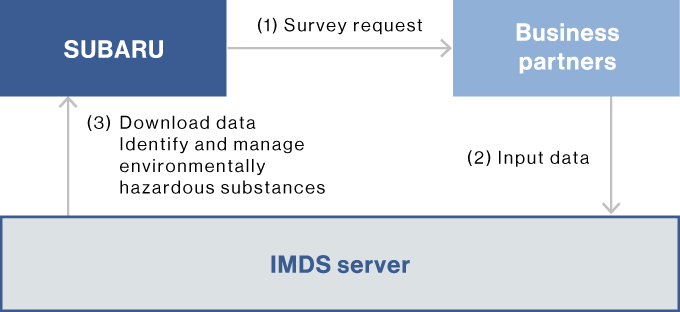
For chemical substances contained in products, we use IMDS*1 as a method to manage our entire supply chain in order to identify the composition and quantities of chemical substances contained in each of the several tens of thousands of parts that comprise our automobiles. Furthermore, we use SUBARU’s proprietary chemical substance management system to substitute and/or manage elimination of substances prohibited under laws and regulations such as the REACH regulation*2, the ELV Directive*3, the U.S. Toxic Substances Control Act, and Japan’s Act on the Evaluation of Chemical Substances and Regulation of Their Manufacture, etc., and to appropriately disclose information on controlled substances required by the WFD*4 and other regulations. This work to manage chemical substances also aids in the SUBARU Group’s work toward resource and other recycling. SUBARU also works with business partners from the design and development stages to reduce environmentally hazardous substances such as lead and mercury, and all new vehicle models launched since 2008 have consistently met industry targets.
For substances emitted during vehicle use, SUBARU develops technologies for cleaner exhaust gases in response to emissions regulations in each country and region. By controlling emissions of hydrocarbons, nitrogen oxides, particulate matter, volatile organic compounds (VOCs), and other substances, SUBARU is working to reduce impacts on air quality.
For chemical substances used or emitted at factories and business sites, SUBARU prioritizes legal compliance while setting voluntary standards stricter than statutory limits and managing emissions to reduce environmental impacts. These initiatives help prevent impacts on the surrounding environment and reduce environmental risks.
In this way, SUBARU enhances the effectiveness of its chemical substances management by managing substances contained in products and those used or emitted through business activities according to their respective characteristics.
Coexistence with Nature: Proper Management of Environmental Impact
- *1
- IMDS: International Material Data System, an international materials database for the automobile industry
- *2
- REACH (Registration, Evaluation, Authorisation and Restriction of Chemicals) Regulation: A European regulation requiring all chemical substances to be subject to management or restriction measures commensurate to the risk that they pose to humans and the environment
- *3
- ELV (End-of-Life Vehicles) Directive: A European automotive disposal directive requiring reduction of environmental impact from vehicles that are no longer used
- *4
- WFD (Waste Framework Directive): A European directive requiring waste control and management
Management of Chemical Substances through the IMDS

Environmental Education
SUBARU aims to ensure that employees understand the environmental management system (EMS), recognize the environmental issues relevant to their respective duties, and conduct business activities accordingly. To this end, in addition to general education for all employees, SUBARU provides a variety of environmental education programs tailored to different job levels and duties, including training for new employees and mid-career hires. SUBARU also engages in training for effective EMS operation, including training for EMS promoters and internal auditors.
SUBARU also provides training and support for obtaining qualifications. By promoting the acquisition of environmental qualifications such as Pollution Control Manager, Qualified Person for Energy Management, and Specially Controlled Industrial Waste Control Supervisor, SUBARU is strengthening and improving the quality of its environmental promotion system.
Engagement in Policy Development through Industry Associations
To help achieve a sustainable society, SUBARU emphasizes dialogue with governments and relevant institutions and works with external organizations to advocate to governments.
In the area of climate change, SUBARU is fully committed to achieving carbon neutrality by 2050 across the entire life cycle. For key issues such as improving fuel efficiency, developing next-generation vehicles, and reducing CO2 emissions, SUBARU works with external organizations in each country and region and advocates for policy development. In the U.S., a key market, SUBARU advances effective policy proposals through organizations such as the Alliance for Automobile Innovation (AAI) while responding to local regulatory developments.