
 |
|
 |
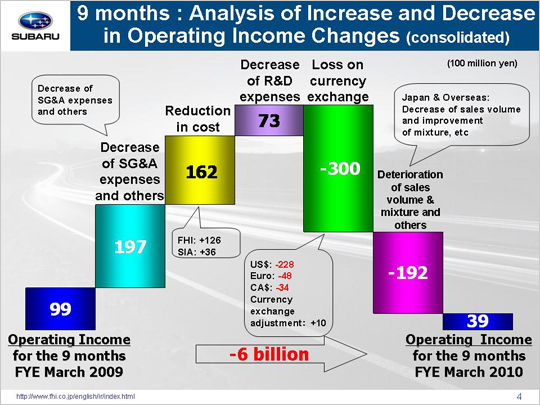
| Now moving on to the factors behind the year on year change in operating income for the nine-month period under review that saw earnings drop from 9.9 billion yen to 3.9 billion yen. The primary reason for the earnings jump was an increase of 19.7 billion yen as a result of reduced SG&A as well as other expenses. This amount reflects the overall stable fixed manufacturing costs with an increase of 3.3 billion yen at FHI (Fuji Heavy Industries) and a decrease of 3.3 billion yen at SIA (+0.5 billion yen due to fixed processing costs decrease and -3.8 billion yen due to increased expenses associated with suppliers' dies at FHI, and +$30M due to decreased expenses associated with suppliers' dies and no change in processing and other costs, resulting in a gain of $30M at SIA). The remaining portion can be broken down into two factors: (1) A decrease in SG&A expenses that resulted in a gain of 22.6 billion yen. This included a gain of 8.8 billion yen at FHI as a result of efforts toward reducing advertising and SG&A expenses. Domestic dealers have also worked on cutting SG&A and other expenses through consolidation of distributors, resulting in a gain of 6.2 billion yen. SOA generated a gain of 2.3 billion yen ($23M), which included a gain of $40M due to an approximate $500 reduction in the per-unit incentive of $1,500 for January-September 2008 to $1,000 for April-December 2009 despite increases in advertising expenses of $9M and SG&A expenses of $8M. Our Canadian subsidiary generated a gain of 1.0 billion yen by cutting incentive and advertising costs. Other subsidiaries also saw a gain of 4.3 billion yen through cost reduction efforts. (2) An increase in costs associated with warranty claims led to a loss of 2.9 billion yen. We had made an allowance for costs associated with warranty claims in overseas markets during the first half of the fiscal year. We gained 16.2 billion yen due to a reduction in materials costs, 12.6 billion yen at FHI and 3.6 billion yen at SIA. FHI witnessed a reduction in materials cost of 6.9 billion yen and a gain of 5.7 billion yen after recouping the losses from the previous year's price hikes for raw materials. SIA made a gain of $34M, including $16M due to a reduction in materials cost and $18M after recouping the losses from the previous year's jump in materials prices. We gained 7.3 billion yen due to a reduction in R&D costs (from 34.0 billion yen to 26.8 billion yen). This explains the temporary lull in new model development and our ongoing efforts toward increasing R&D efficiency. Among the factors that took a bite out of our operating income, was a loss on currency exchange of 30.0 billion yen due to exchange rate fluctuations. This includes a loss of 22.8 billion yen due to an approximate 10 yen appreciation against the U.S. dollar, a loss of 4.8 billion yen due to an approximate 22 yen appreciation against the euro, and a loss of 3.4 billion yen due to an approximate 12 yen appreciation against the Canadian dollar. This figure also includes a gain of 1.0 billion yen since foreign exchange adjustments for transactions between FHI and its overseas subsidiaries, which used to be classified as "SG&A expenses and others," are now classified as foreign exchange gains/losses from the beginning of this fiscal year. FHI's sales rate is based on the average rates applied during the previous month and adjusted for the difference between its subsidiaries' spot purchase rates. We suffered a loss of 19.2 billion yen due to deterioration of sales volume and mix and others. These can be divided into three areas: (1) In the domestic market, the sales volume and mix were better than expected thanks to the positive effect of the new Legacy, which led to a gain of 0.9 billion yen despite the declined sales volume for minicars. (2) In overseas market, we suffered a loss of 8.6 billion yen. This was due primarily to FHI's control of production and reduced shipping volume during the first half of this fiscal year. (3) We lost 11.5 billion yen due to inventory adjustments and other factors. These factors combined brought operating income down 6.0 billion yen to 3.9 billion yen. |