
 |
|
 |
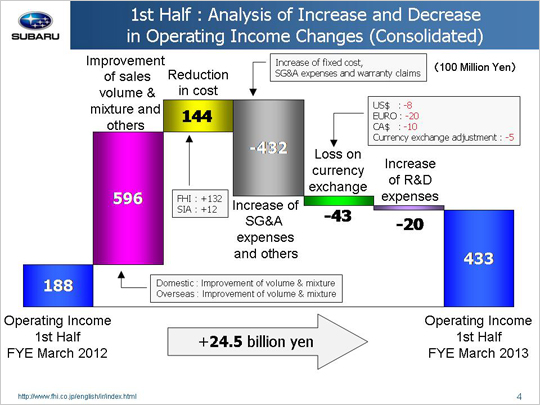
| Let’s look at the reasons behind the year-on-year increase of 24.5 billion yen in operating income that went from 18.8 billion yen to 43.3 billion yen. The primary reason for the earnings increase was a gain of 59.6 billion yen due to good sales mix variances. This gain can be broken down into the following three areas. First, we saw a gain of 5.2 billion yen in domestic sales of new models. Although minicar sales fell, sales of passenger vehicles, including the Impreza, drove overall domestic sales up. Next, we saw a gain of 36.1 billion yen in overseas sales of new models. Robust sales of the Impreza brought sales for the first six-month period way up, significantly exceeding sales for the same period last year which saw a slump in production and sales due to the March 11 earthquake. Finally, we had a gain of 18.3 billion yen due to inventory adjustments and others. Another factor behind the boost in operating income was a gain of 14.4 billion yen related to materials costs. This includes a gain of 13.2 billion yen generated by FHI as well as a gain of 1.2 billion yen coming from SIA. FHI generated a gain of 8.8 billion yen from reduced materials costs and another gain of 4.4 billion yen due to lower materials prices and better market conditions. SIA yielded a gain of 1.4 billion yen through cost reductions and a loss of 0.2 billion yen due to materials prices, etc. The main factor bringing operating income down was a loss of 43.2 billion yen due to increases in SG&A expenses. This loss can be broken down into the following three areas. First, we see that an increase in fixed manufacturing costs generated a loss of 20.3 billion yen, with a loss of 18.8 billion yen coming from FHI and another loss of 1.5 billion yen at SIA. FHI generated a loss of 6.8 billion yen due to increased costs for suppliers’ dies and a loss of 12.0 billion yen due to higher fixed processing costs. SIA lost 0.8 billion yen due to higher costs for suppliers’ dies and 0.7 billion yen due to an increase in fixed processing costs. Next we see that an increase in SG&A expenses led to a loss of 20.8 billion yen. SG&A expenses also surpassed what they were during the same period last year when they dropped in the wake of the March 11 earthquake. The 20.8 billion yen loss also includes a loss of 4.5 billion yen at FHI from transportation and packing cost, 0.1 billion yen at domestic dealers, a loss of 9.3 billion yen generated at SOA from higher sales promotion costs related to the increased sales volume, a loss of 0.3 billion yen at our Canadian subsidiaries, and a loss of 6.6 billion yen from other operations. The third and last factor includes an increase in costs associated with warranty claims that led to a loss of 2.1 billion yen. Another contributing factor that brought operating income down was a foreign exchange loss of 4.3 billion yen. This drop includes a loss of 0.8 billion yen due to a slight appreciation of the yen against the U.S. dollar, a loss of 2.0 billion yen due to an approximate 11 yen appreciation against the euro, and a loss of 1.0 billion yen due to an approximate 4 yen appreciation against the Canadian dollar. This figure also includes a loss of 0.5 billion yen due to foreign exchange adjustments for transactions between FHI and its overseas subsidiaries. Finally, an increase in R&D expenses resulted in a loss of 2.0 billion yen. These factors combined brought consolidated operating income for the first six-month period of the fiscal year ending March 2013 up 24.5 billion yen to total 43.3 billion yen. |